‘We Are All Strangers’: A Patient Wonder of Belonging
We Are All Strangers. Giraffe Pictures
There are two moments in Anthony Chen’s We Are All Strangers that give breath to the film’s spirit, despite arising from a character who is mostly rendered to the side of the drama. Lydia’s (Regene Lim) mom drags her to church, and Chen observes the rites of Singaporean Catholicism as the priest reads from Romans 12. The exhortation of St. Paul will rattle about with the ricochet of events that will follow: “Do not conform to the pattern of this world, but be transformed by the renewing of your mind.” Back at home in the course of an argument between them, Lydia’s mom poses a similar piercing challenge, more concise than Paul’s. “How can you trust a boy you met at a BTS concert?” Truly a question for our times.
We Are All Strangers tenderly walks the paths that bring disparate people into the same, shared life of one family. These are rocky, uneven paths, filled with accidental stumbles, followed without any sense of direction. But they’re leading somewhere, even if the road is long.
Junyang (Koh Jia Ler) is on the cusp of adulthood, wrapping up his mandatory stint in the military and dreaming of a big life ahead of him. But his current life kicks against his aspiration. He lives in a small apartment with his father, Boon (Andi Lim), who owns a small noodle shop in a local food court. His father works to survive and provide for himself and Junyang, and, along with demonstrating kindness to others around him, he contents himself with those goals. Junyang, though, is a child of the internet. He has abundant access to the lavish lifestyles of influencers, the stardom of K-pop bands and TikTok streamers. So much access, seemingly so close to his fingers as they swipe across the screen.
When an unexpected (though entirely predictable—you probably already see where this is heading) event finds Junyang and Lydia thrown into marriage, the small apartment must find room for one more. Meanwhile Boon is discovering a sense of romance, himself, as he tentatively asks out Bee Hwa (Yeo Yann Yann), who works in the same food court. Soon there are more people than this apartment has space for.
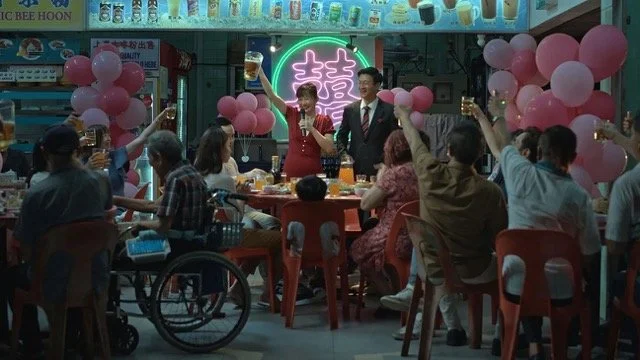
Chen’s film (running two and a half hours) is an intimate family drama that expands into a grand story. It maintains a gentle, deliberate pace as it captures the highs and lows of family life. We watch the first blush of rushing interest in another person, whether one is still a teenager or nearing retirement; we also see the relational prejudice and conflict that these changes spark. The highs and lows of life in Singapore are also on display, never more clearly than in the quick succession of weddings in quick succession, the first at a five star hotel that breaks the budget, the second in a food court (which doubles as a workplace). Throughout its tale, We Are All Strangers will take significant turns, though in a movie this patient, it would be unfitting to call them twists. Every time the film diverges, it shocks the expectations, but it consistently allows us the space and time to settle into each new path until it feels like the road this story was always on. It’s a wonder of a screenplay pillared by strong performances. (Yeo and Koh are familiar collaborators for Chen, also appearing in Ilo Ilo and Wet Season.)
There’s plenty of conflict in this new family (as Chen’s title underlines). Junyang is frustrated enough about a new stepmother, but he’s especially angry that she doesn’t fit his expectations—Bee Hwa’s Malaysian, not Singaporean, and a “beer auntie,” to boot. Everyone else, meanwhile, is getting fed up with Junyang’s lack of responsibility: he dreams of entering the rarefied air of the upper class, but he seems to have already adopted that demographic’s allergy to actual work.
It’s at this intersection that We Are All Strangers arcs toward social critique like fireworks—not yet exploding into bursts but tracing a thin line against the night sky. Conforming to the ways of the world is a dynamic we don’t even notice in a market-driven society exacerbated by the illusions of social media. This is all Junyang can think about, even as it paralyzes his ability to act for his immediate needs. He gets his chances, but they prove deceptive or fleeting. A job selling lavish, smart condos to foreigners begins with his employers forcing him to adopt a Western name (“Steve. Like Steve Jobs!”). It will end ignominiously, but that’s really how it began and how it carried on the whole time. He’ll also turn, with Bee Hwa’s help, to hocking secondhand medical products during livestreams, which will bring its own consequences.
Chen moves through each character’s path with grace and a reserved style. The beauty of his images (the cinematographer here is Teoh Gay Hian) frequently draw one’s gaze and spirit up from the earthbound cares of the story. The film opens with a good cooking scene as Boon prepares noodles—and who doesn’t love those? As characters walk home at night, the mise-en-scène is awash in the play of cool and warm lights creating havens in the dark street. But the most moving scene simply observes Bee Hwa eating an apple on the bus—no dialogue, no added emphasis, just the gradual shifts of Yann’s expression conveying the substance of the film’s compassion.
We Are All Strangers is permeated by a sincerity that avoids ever becoming overstated or overwrought. It is a patient film that rewards patient viewing (though it never becomes full-on slow cinema). It encompasses the global by inserting us into the personal; as Chen remarks on the film: “Where the world literally washes up on our doorstep, is where the deepest human dramas unfold.” When the world washes over us—its waves of economic concerns and lifestyle dreams and its currents of consumption—how will we resist its conforming flow that threatens to erode our humanity?