Everybody Digs Bill Evans. Hot Property Films
Jazz on film, or rather jazz as film, presents a complicated problem. Finding a way for a movie to match the tempo, discursive collaboration, and improvisation that distinguishes jazz as an art form is no mean feat, especially maintaining sufficient clarity for the viewer. Often the power of jazz overwhelms a film that can’t match it—Elevator to the Gallows is a fine film, but Miles Davis’ score is an all-timer. When a film pulls it off, though, it’s electrifying.
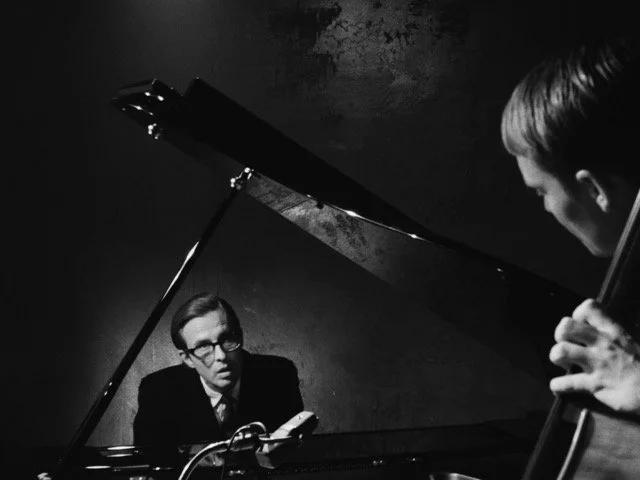
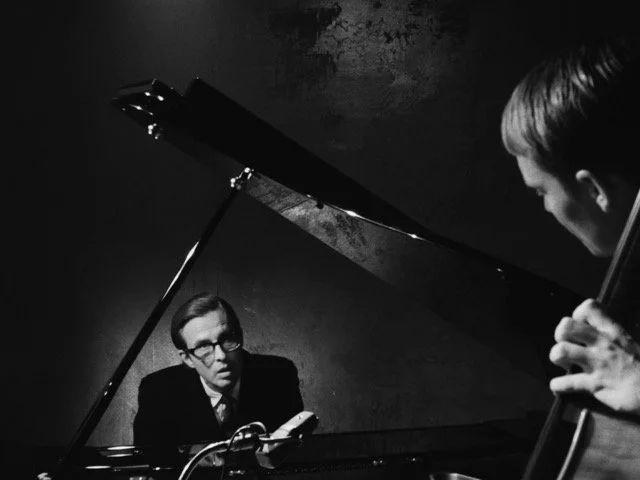
The opening of Grant Gee’s Everybody Digs Bill Evans belongs in the category of great cinematic depictions of jazz. Gee and cinematographer Piers McGrail approach the performance by the Bill Evans Trio with innovation and constraint. The camera never roves or swerves (as it does memorably, effectively in Whiplash); in fact, it’s almost entirely composed of static shots that form extreme close-ups on the instruments and the players. The camera parallel to the piano’s keys, close enough to only frame ten or so, giving each note and chord a stark vertical geometry. A fragment of the bass’ neck, as well, so close that each pluck transforms the taut strings into vibratory blurs. The cymbal cuts at an angle, breaking the verticality, again emphasizing the impact of each percussive strike.
The date is June 25, 1961, and we are at the Village Vanguard. Tonight not one but two albums (Sunday at the Village Vanguard, Waltz for Debby) will be recorded from the trio’s performance. And ten short days later, bassist Scott LaFaro will die in a car accident. As the band continues to play, Gee gives prophetic match cuts: the bass strings fade into the road’s centerline markings, the recording tape spinning becomes the car’s wheel. The ensuing tragedy and all its wreckage is folding back in on this night, haunting all its joy.
After LaFaro’s death, the music that expressed Evans’ spark and companionship with his band will become a mausoleum. It entombs him, seals him off from the world of the living. Everybody Digs picks up here, and it stays here almost exclusively—the film is based on Owen Martell’s book Intermission, an apt title. Evans spirals into heroin addiction and solipsism, bouncing between his brother’s apartment and eventually his parents’ home in Florida. Most of the film takes place with his parents, and he’s immediately framed between them. Trapped, caged. Bill Pullman and Laurie Metcalf are wonderful in these roles.
Battles with addiction are nearly as familiar to music biopics as songs themselves, so centering a film on Bill Evans’s retreat into drugs and grief is a gamble. But Gee’s visual style and narrative restraint navigate the typical pitfalls with poise. The film is arrayed in black and white and lit brilliantly for it. It’s beautiful, though its beauty is at times marred by blurring images and rapid edits that break the flow of time and remind us that this is a hazardous point in Evans’ life. The dense grain filters into his hazy mental state like the static of an old record. There are punctuations of color as the film jumps ahead into the 1970s—they fit thematically, but they sap the film of its enclosed, restless energy somewhat.
The occasional visual fury is pulled back by Anders Danielsen Lie’s (The Worst Person in the World, Sentimental Value) acting. Lie’s performances are always tuned to make quiet, hesitant touches reverberate, and he is a wise fit for a script of tacit responses. Evans seems determined to give everyone the bare minimum—he hardly speaks, and he certainly never speaks his mind. When someone says “I love you, Bill,” the reply is a tongue click and a terse nod. But Bill Evans, in Lie and Gee’s hands, never becomes a cypher. His distance and reserve are understood to be innate to his personality, not a source to generate mystery. He himself describes it well, though he intends to convey the feeling of playing music: It’s a matter of “pushing the world away so you can think with your hands.” In the way that jazz makes use of silence and negative space to accentuate its rhythm, Everybody Digs elicits pauses and silhouettes to give us a picture of who Bill Evans is.
Early in the movie, Bill attempts to describe LaFaro’s genius and friendship, but he realizes his words will fail. “It’s not something you can untangle easily.” Neither is grief. By narrowing to this slice of Bill Evans’ life, Every Digs provides more of a glance into the artist instead of a complete biopic. It is a stark, sometimes dim view, and always fleeting. Like the opening images, it’s an extreme close-up, one that seeks to convey the energy and tone of a person’s world rather than its logic.