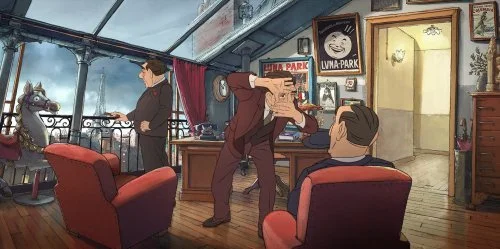
In setting out to capture Marcel Pagnol’s life, filmmaker Sylvain Chomet aimed to depict “memory with animation.” It’s these twin aspects—memory and medium—that most fully express the character of A Magnificent Life. Chomet (The Triplets of Belleville, The Illusionist) has used animation in previous films, though the decision to employ the technique for a biopic is atypical. The film is arrayed in watercolor tones akin to The Illusionist more than Triplets, though it interjects influences from city maps, period posters, and cinema, itself. The result is a straightforward and sentimental consideration of an artist that is no less effective for the sincerity of its charm.
Marcel Pagnol’s life is told in the framework of reminiscence: past his artistic prime (or at least his popularity), Pagnol is approached by Elle to write a serialized memoir. After decades of inspiration, telling his story directly proves a challenge until young Marcel, manifested as a visage of his childhood, appears in his room to refresh his memory. Despite the necessity of revisiting definite pains—beginning with the death of his beloved mother—Marcel is a well-intentioned ghost of years past.
The doubled framework (of memoir and spiritual journey through memory) takes a direct path through Pagnol’s childhood woes, the burgeoning artistic passion of his adolescence, an impulsive move to Paris and into his creative career. Pagnol was first a playwright, staging his early works Merchants of Glory and Topaze in the 1920s. Growing acclaim found him portraying a caricatured Provençe of his youth in Marius, which marked a substantial gambit that paid off, but the risk of emphasizing the Provencal dialect on Parisian stages was nothing compared to his next aim.
In the late 1920s, Pagnol visited London and fell under cinema’s seductive spell. On the cusp of the sound era, Pagnol ventured to recreate Marius as a movie, signing a deal with Paramount Pictures. The movie was a success, though the collaboration with Paramount was short-lived, so Pagnol created his own movie studio and would go on to produce many successful movies, including Manon of the Spring and Jean de Florette. Other challenges would come: World War II, German occupation of France, and eventually the changing tastes of French audiences.
Chomet moves through the chronology with very few breaks, and even fewer personal complications. In today’s movie landscape, the biopic is nearly synonymous with a complicated portrait of a distinct personality, where the unanswerable multiplicity of humanity is in focus as much as any given figure. A Magnificent Life is an anachronism in this sense, always foregrounding Pagnol’s artistic dreams and integrity. His artistic drive is directly linked to a childhood promise; failed loves are speed bumps on his journey; and the criticisms of jumping from the theater to the cinema pose just as big of an obstacle as German occupation.
While the film maintains an uncomplicated arc, however, the animated format allows Chomet to be inventive and playful. Most notably, the film frequently interweaves the format of the theater or the cinema into the style of the film. For example, Pagnol’s trip to London is told as a faux silent film complete with intertitled discussion between his adult self and the young Marcel. It’s this inventiveness that makes A Magnificent Life nimble and joyful, overcoming the simplicity of its structure.
A Magnificent Life is not likely to reach a wide audience, but it’s a sincere and effervescent celebration of a significant artist. For those who are interested in Pagnol, twentieth century French theater and cinema, or simply vibrant forms of animation, then A Magnificent Life is worth hunting down.