The Secret Agent. MK Productions
Kleber Mendonça Filho’s The Secret Agent has garnered Oscar nominations in some of the weightiest categories, including Best Actor (for Wagner Moura), Best International Feature, and Best Picture. It’s a movie all about connections, the ties between the past and the present, between witnessing and studying violence, between money and ideology, and between fictional monsters and those we encounter too frequently in our world.
The Secret Agent is also a film about deception, and that begins with its title. Wagner Moura’s Marcelo is on the run from those with nefarious intent, and we gradually come to learn that he’s traveling under an assumed name. But he’s not the spy that we are initially inclined to presume. He’s not handy with a gun, and though he does exclaim “I know how to use a hammer,” violence is not his modus operandi.
It is the operating principle of his context, however. The Secret Agent takes place in 1977 Brazil, which the opening instructs us was a “period of great mischief.” The first view of Marcelo comes as he stops to fill up his bright yellow VW Beetle, only to notice a dead man’s body laying under some cardboard by the gas station. Don’t worry, the attendant reassures him, it’s just a robbery gone wrong from a few days ago. When the police do arrive—inconveniently before Marcelo can escape—they pay no attention to the violence lying on the ground in front of them. Instead they focus their attention on harassing Marcelo and trying to find a reason to extort him.
The opening lays the tonal and narrative groundwork that will persist like a rhythmic beat throughout the film. Every small choice or coincidence is poised at the edge of catastrophe, such that the mundane becomes ripe soil for tension to burst up from the ground at any moment. And where those in positions of order and power should protect, they instead exploit and plunder, like a pack of dogs rooting around a dead body. Violence is never far.
But any moment of breath is also suffused with a seductive energy. The Secret Agent is radiating with color and music that constantly pairs the diegetic sounds of records and festivals with its score. And Wagner Moura’s plentiful charm works much the same magic—even in his moments of fear or grief, we’re electrified by Marcelo’s charisma. It all creates a bit of a dilemma: this is clearly a dangerous environment, yet we’re repeatedly pulled in not just by plot mechanisms but by our desire to spend more time here. (And indeed, I could have happily spent another hour in this story.)
More impressive still is the ways in which Filho’s film inserts complexity into his stylish narrative by being aware of its nature as a narrative. The Secret Agent is filled with clear callouts to other films, as Jaws, King Kong, and The Omen all receive direct callouts. Notice, too, the theme of this metatextual flourish: the monsters we are obsessed with in our fiction. In fact, fiction begins to fold back in on Marcelo’s reality, as the public’s fervor over Jaws meshes with the discovery of a human leg found in a shark’s body, resulting in the creation of the “hairy leg” urban legend—a real urban legend that has its roots in news media censorship under Brazil’s military dictatorship. But that’s not recursive enough; we also jump into the future, where young university researchers listen to audio recordings of Marcelo and other citizens, documenting histories that would otherwise be lost.
Thus the characters (that is, those who are not perpetrating violence) form a tripartite public: the engaged audience of fictional, cinematic violence; the unwilling witness of real violence; and the students of history tracing the legacy of violence. Filho sows the idea that just as the events of the past are formative for the time we’re in now, so are the concerns of the past vital for our contemporary questions. The ways a society is willing to return to and reveal and wrestle with its past postures its stance toward the future. The Secret Agent extends its concerns beyond just police corruption to also consider how corporate money contorts universities and their research, how political oppression creates a demographic of refugees within their own country.
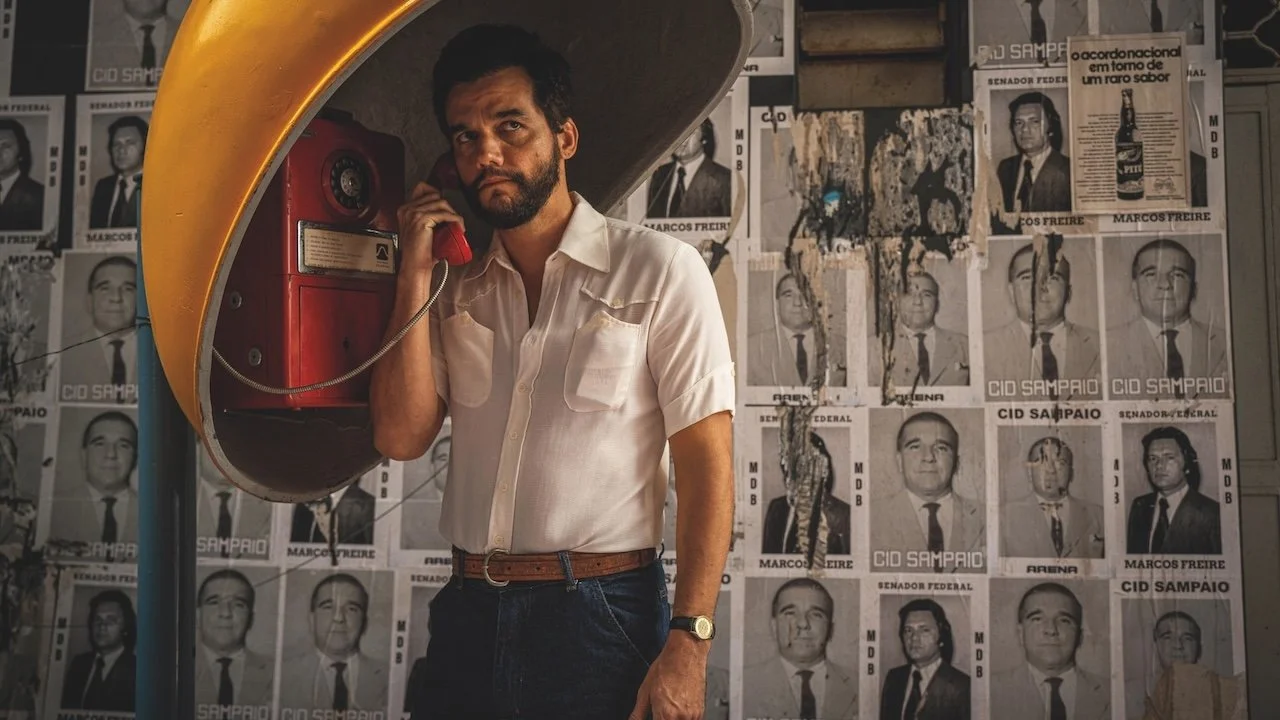
None of this is moralizing in The Secret Agent, as these critiques are always integrated smoothly within Marcelo’s journey. The uses of color are particularly striking and complex throughout the film. His Bug is only the first instance of bright yellow, which comes to set aside a space (or an object) that should be a safe haven—but this idea of safety is always fractured. His car, a phone booth, the uniform of a man delivering a telegram. The saturated hues mark spaces permeated by authority, by threat, so that the apparition of yellow comes to invoke alarm instead of cheer. Likewise, blue is associated with home, particularly with his father-in-law (Carlos Francisco), who’s often in a blue shirt and works in an azure projectionist booth. But this is a home that Marcelo lost, that has become inseparably weighted with the loss of his wife (Alice Carvalho).
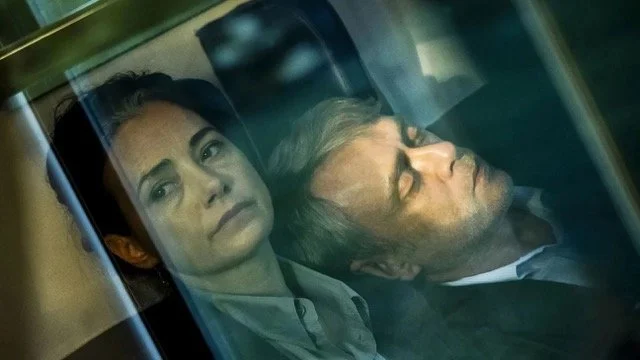
The uses of music and camera are also far from simple. Evgenia Alexandrova’s cinematography is remarkably versatile in early driving sequences, finding an array of angles to display Marcelo and his surroundings. And there’s a split diopter shot late in the film that serves to project Marcelo’s psychological geography—a gorgeous decision at a pivotal moment. And the score, along with diegetic music, bounces between omen, heart, and verve on a dime.
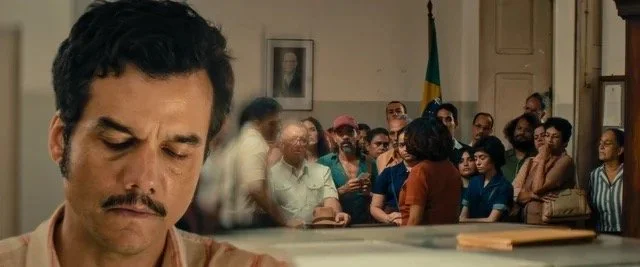
Split diopter in The Secret Agent (MK Productions)
The Secret Agent is a significant film with weighty matters at its heart. It’s also a stylish and tense film—it’s a lot of fun. I’m not sure if it will take home any of the big awards this Sunday, but whether or not it does win, it’s worth stepping into its world. Just watch out for errant legs.