‘Heysel 85’ and the Collapse of Political Ineptitude
Heysel 85. Topkapi Films
Dictums about the importance of remembering the past bounce around us with such frequency that their repetition ceases to mask their weakness. We must ask what these social liturgies actually accomplish. So often spoken in familiar, self-congratulatory admonition (“Those who forget the past…”), they do not so much act as an exhortation to the hearer but as a reassurance to the speaker. It’s a consoling blanket, reminding the one who offers such wisdom that they are without a doubt on the right side of things. Pandering placebo, it still keeps the past at a distance, it keeps us falsely sheltered in our “better” present.
What about instances where the past forcefully inserts itself into the present with frightening relevance? There’s a cacophony of them these days for those with ears to hear. In such times adages provide no refuge; instead, they reveal themselves to be impotent bulwarks against the harsh realities that must be faced.
Heysel 85, directed by Teodora Ana Mihai, is a film about such a puncture. Set during a stadium disaster in Brussels in 1985, the film charts how mistakes build toward disaster, and how the ineptitude of governments creates a farce even as victims lie bleeding. In many ways, Mihai’s film feels like In the Loop (or pick any other of Armando Iannucci’s work)—if every ounce of humor were vacuumed out of the satire. It’s too real, too chilling, to elicit a laugh. Instead, Heysel 85 generates a miasma of dread and anger at uncaring systems.
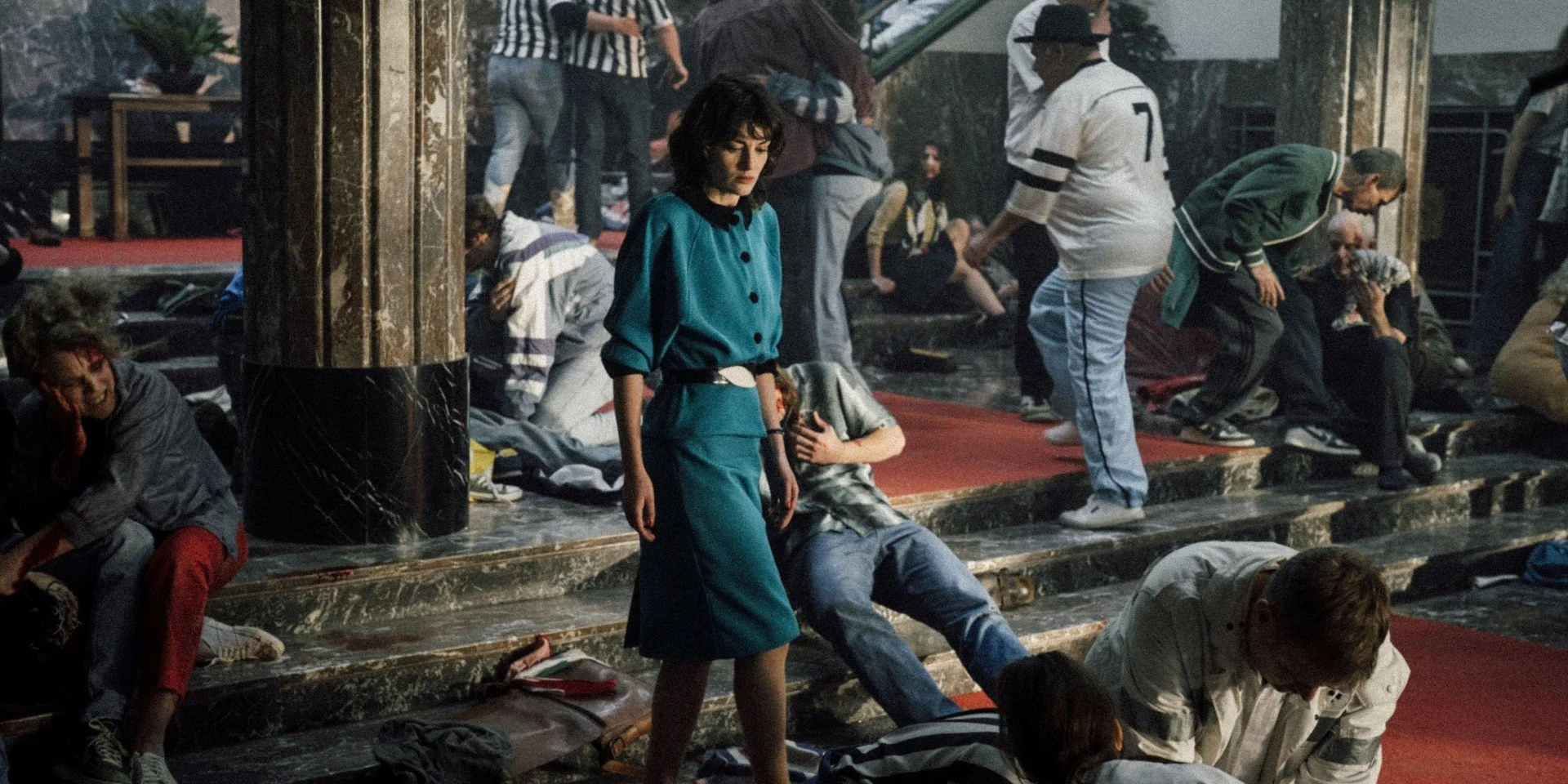
Marie (Violet Braeckman) is the daughter and press secretary of Brussels’ mayor (Josse De Pauw), and she’s the only one in the crowd of politicians who seems to confront the severity as events begin to spiral. The Heysel stadium is rundown and in need of upgrades, but the mayor has no interest in spending money on it before the European Cup final match between Liverpool and Juventus. That’s only the (shaky) foundation of the issue. A preponderance of scalped tickets have placed Italians and Liverpool fans—normally divided into separate sections—right beside each other. Some Liverpool fans begin throwing objects at the Italians, and eventually charge them. As the Italian crowd rushes to flee, a section of the stands collapses. Many are crushed, more are trampled, and others injured in the attacks from violent fans. In the aftermath thirty nine people were pronounced dead, with hundreds more being treated for various injuries.
Mihai alternates between archival footage (which is articulated clearly through news footage and camera timestamps), the urgent journeys of Marie and reporter Luca (Matteo Simoni) through the halls of the stadium to find help, and the arrogant lack of urgency among the mayor and other politicians. There’s a refrain that occurs throughout Heysel 85, on the lips of anyone who’s supposed to hold power: “I’m not responsible for…” Those with status are shifting blame before the disaster is even over, as the body count slowly ticks up. Marie is the only one in the room panicking—sometimes, the most judicious response. She does what she can to act morally, responsibly, but it’s hard in a sea of bureaucratic toadies.
Various power dynamics sediment into layers, each strata allowing Marie only a limited ability to act. Her father’s alcoholism puts him out of effective government; she could take charge, if only she didn’t have to spend so much energy running interference for him. When she eventually acts as translator between the Belgian, Italians, and English, she repeatedly gets told to “stick to translating,” with the men in the room seeing her as incapable of anything other than that function. Which of course weaves in the politicians’ sexism, as well. Heysel 85 is sharp about the intersection of these dynamics, especially with regard to the politics of language. What gets translated literally and what only gets summarized? What gets shared, and with whom?
Much of the film sticks to the underbelly of the stadium as she interacts with police officers, the football teams, reporters, medical personnel, and the victims. There’s enough archival footage of the actual events that we have a sense of the violence taking place just out of frame, and these hallways become oppressive, claustrophobic. Mihai weaponizes this space so that it almost scans as a horror film at times for all its grime and tension. But it’s the grime of civil neglect, the tension of societal mismanagement.
The film takes the overlooked aspects of governing and unveils how even these societal failures can cause death for those within it. Marie is clear eyed, but her power is restrained: early she remarks that they “need to be quick and smart” in their response. But they are neither, and what unfolds instead is farce and scandal. Heysel 85 reanimates a recent tragedy—little known in context of so many other, larger tragedies of the last forty years—in such a way to pose tough questions for today’s political society. Are those in power interested in caring for those they represent, or are they more invested in representing their own image? How much of Marie’s inability to resolve problems comes from others’ prejudices (certainly a lot) and how much comes from her compromised position in the system (perhaps as much)? The hallways of the stadium represent the real, the landscape where tragedy occurs, while the well stocked bar of the politicians is an enclave where diplomatic vitriol ignores the actual suffering of humans. How can leaders truly serve their society when such an insuperable gap exists?
There are no easy answers. Our adages have no power here. They didn’t help in 1985, and it’s doubtful they will in 2026. But as Heysel 85 pierces our present with the horror of the past, it forces us to confront the ever present gap between what our government should be and what it actually is. We’re not doomed to repeat or return to the past, we’re ignoring that we hardly left it, that such structural problems never left us at all.