‘Tutu’ Proclaims its Subject’s Spiritual Energy
Tutu. Hidden Light
Sam Pollard’s documentary Tutu has left me pondering a question: Are we lacking the bold, prophetic voices necessary to counter the wrongs of our own society today, or are we merely not listening to the ones that are already crying out?
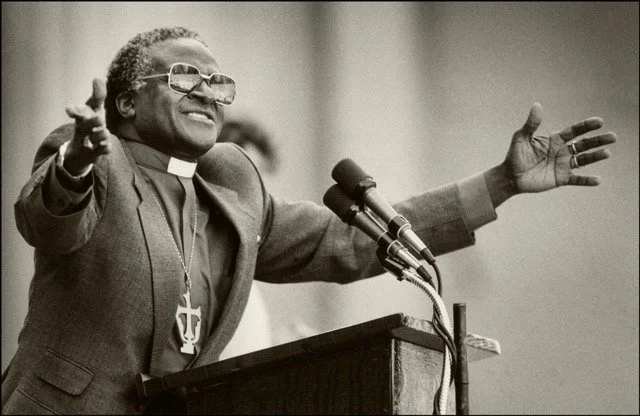
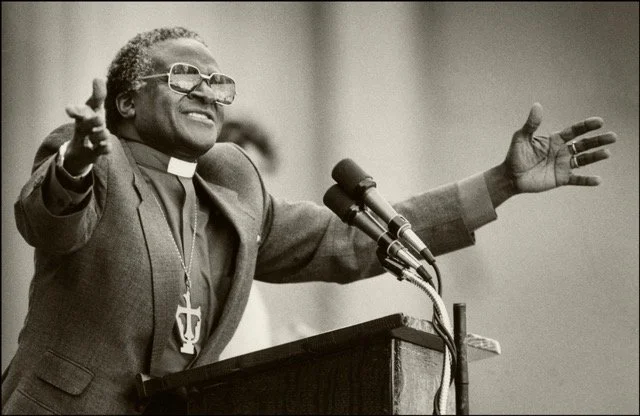
Pollard’s film pieces together archival footage of Desmond Tutu, the South African bishop and outspoken anti-apartheid activist, along with footage obtained by cameramen who spent years with Tutu and his family. The latter sections add a substantial, personal view of Tutu which only underscores the vibrant, ebullient personality he displayed in public.
The structure is straightforward, largely tracking chronologically as Tutu speaks against apartheid at its height, his connections to activist Steve Biko, his appointment to the bishop of Johannesburg and later to archbishop of Cape Town, his time at the helm of the Truth and Reconciliation Committee, and his later life speaking out against injustices around the world.
What the documentary crystallizes—reaffirmed by those who speak of their encounters with him—is that the two sides of Tutu, religious and political, were of one nature. His emphatic political activism was rooted in his faith, and that activism in turn fed into his devotion to prayer and worship. In his own words, every statement he made from the pulpit or in front of a camera was inspired by “the kind of God I worship.” When the fall of apartheid seemed like an impossibility, maybe only reserved for the new heavens and new earth, he carried on with the declaration that “the Christian faith is hopelessly optimistic.”
It’s impossible to watch Pollard’s documentary and not be touched by the archbishop’s abundant spiritual energy. But while it’s easy decades on to see Tutu’s quest against systemic injustice as righteous, the film also serves as a reminder of how fraught and disputed it was at the time. Not only was he opposed by the South African President, Pieter Botha; he was also rebuked at various points by Ronald Reagan, Margaret Thatcher, and other international leaders. And their criticisms ring with familiarity, claiming that his request for economic sanctions would upset the delicate global balance, his statements distort the purpose of the church, and his cries for justice only incite more violence.
Take note: the call for justice is never popular, never welcomed by those who are served by such systems. Such optimism sounds great for the future, but right now? Well that sounds really painful. But Tutu was undeterred in his preaching, in his activism, and in the principles that shaped his life. When South Africans who were ostensibly working toward the same goal turned to violence, he immediately condemned it—he was anti-death through and through. When the Truth and Reconciliation Committee was formed, he insisted that it be an opportunity for amnesty and mercy alongside the unveiling of truth and justice. Again he tied this to his Christian faith: “An extraordinary thing called grace… that’s how God operates.”
Following its subject, Pollard’s film understands that evil spiritual powers are entwined with political powers. And that politics as a game for the accumulation and preservation of power is antithetical to politics as liberation. Tutu thrusts at the viewer the realities of South Africa under apartheid: black men dead in police custody, a raging battle for a nation’s heritage and identity, the false gestures of peace from a government that kills, and disdainful politicians who criticize vocal religious leaders, claiming they’re distorting the Christian message. Let the reader understand.