‘A Prayer for the Dying’ Falls on Deaf Ears
A Prayer for the Dying. Eye Eye Pictures
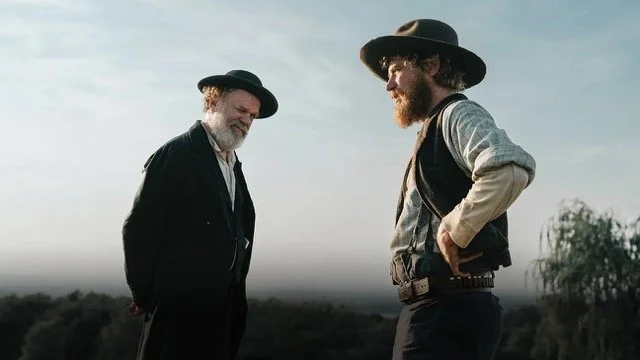
A Prayer for the Dying is undecided about what kind of film it wants to be, and this lack of identity is its ultimate downfall. It would appear to be a Western, on first glance, as the familiar tropes abound: a sheriff and local pastor thrust into conflict, the town doctor, backstories that carry trauma from the Civil War, the centrality of trains. But its central conflict is one of a spreading disease, not something that can be settled by a standoff, so perhaps its aim is aligned with a dramatic character study? Only until it veers strongly toward supernatural horror, as its moody interludes bathed in red and troubling the religious imagery suggest.
Following his time fighting in the war, Jacob (Johnny Flynn) pulls double duty as both the town sheriff and pastor of the town’s main congregation. His approach to both jobs appears to be a noticeable lack of enthusiasm, but he’s called to step up in each role as a diphtheria outbreak threatens the town. Partnering with the local doctor (John C. Reilly), Jacob attempts to contain the disease—as well as his own demons. The film, directed by Dara Van Dusen, makes its title rather literal as the first victims succumb. So Jacob prays, “Hasten the time the reign of peace shall come.” But peace is far from this little town, and diphtheria isn’t the only threat. A Prayer for the Dying tosses in war, drought, fire, heat, and humanity’s mean condition to go along with it.
There’s ample dramatic tension for the sheriff to respond to, but Johnny is equipped to handle precisely none of it. The doctor is far more savvy and capable, but even his actions are futile against such invisible enemies. When he tells Johnny that the only solution is to quarantine the town, citing a previous case, the sheriff asks eagerly: “It worked?” After a hesitant pause, the doctor replies, “it didn’t spread.” From here, the film plays out with a grim, clockwork fatalism. You can’t easily stop the spread of disease. You can’t just command the fire to halt its devastation.
Van Dusen attempts to soak this tale in the diabolical through dreamlike imagery and cinematographic style. There’s a sharper visual tone indoors, but the photography outside meanders in stereotypical Western imagery, at times color grading the frame to reassure the viewer that we are, indeed, in olden times. And there are many pronounced camera movements—slow 360 degree pans or vertical tilts—but such choices fail to constitute a style.
It’s hinted that Johnny is hounded by demons from his exploits in the war, and maybe everything that’s occurring is the advent of judgment. As these moments form an undercurrent, it even seems possible that the devil, himself, is pulling the strings, and that for all his prayers, Johnny’s allegiance isn’t with the benevolent force. But these remain ephemeral and insubstantial, never sufficient to yank the film firmly into horror territory (as something like The VVitch accomplishes to great effect). Instead, it remains caught between genres without fully deploying what makes either so engaging. It’s too earthbound to be intriguingly hellish; too fixated on the supernatural to succeed as a Western; too vague and static to provide a character study. Like it’s hapless, haunted sheriff-pastor, A Prayer for the Dying is simply there, present but never active in all that’s happening.