‘Trial of Hein’ Reveals the Incomplete Construction of Society
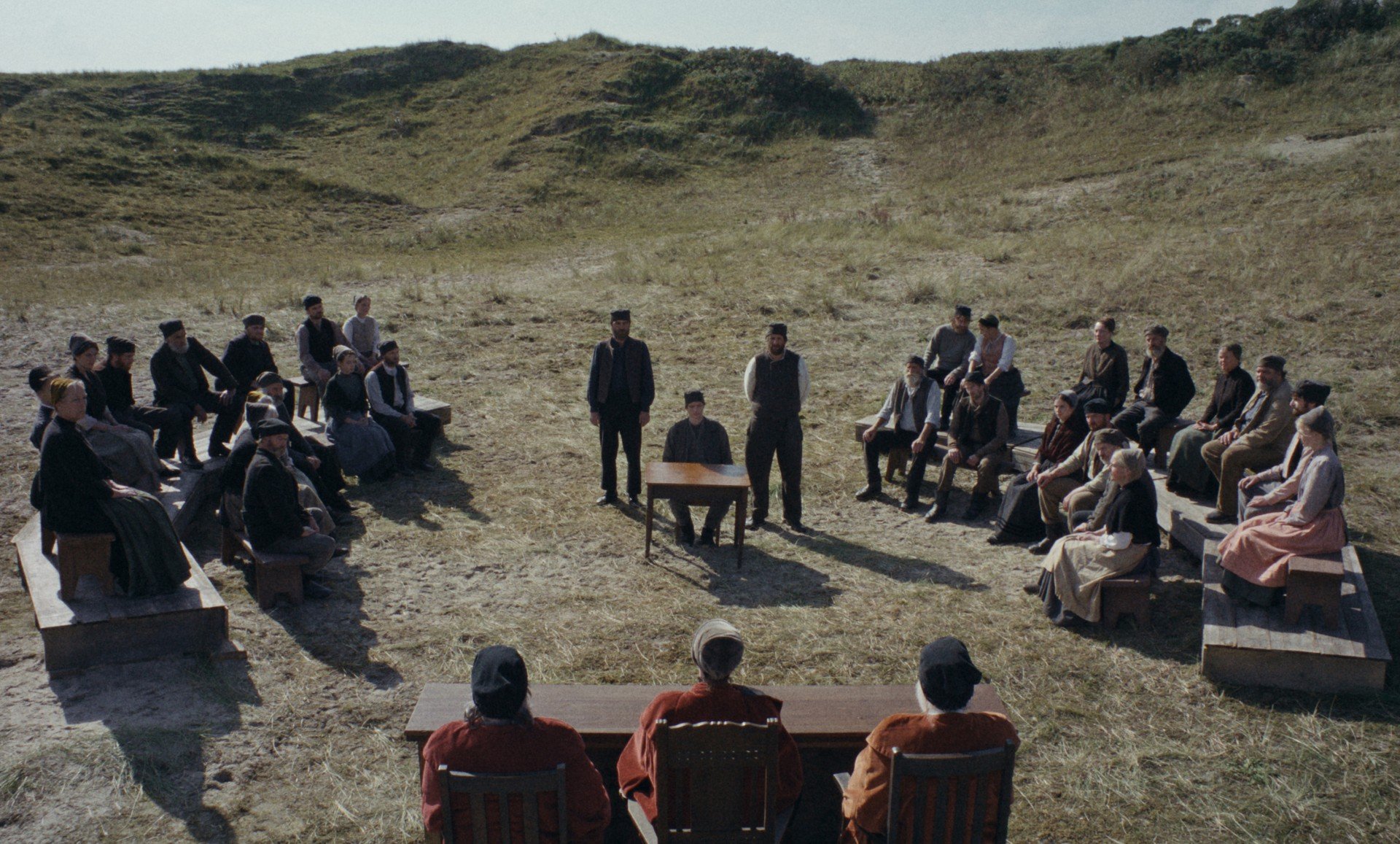
Trial of Hein. Tam Tam Film
Kai Stänicke’s Trial of Hein is a film structured by obtuse geometry from its opening frame. A small sailboat cuts vertically across the frame, the camera situated from above. The water is a stark blue against which the white sails cut bold designs. This framing is crucial to the movie: it will be used repeatedly as characters gather, as individuals walk across the landscape of their island setting. The views from above and the geometric frames imply a structure, but of what—and whose—order? Is this a God’s eye view, one of omniscience and attention? Or is it a device to distance us even further from the truth, the interior lives of these people?
Hein (Paul Boche) is returning home to this isolated German island after fourteen years on the mainland. In that time he has changed, of course, as have his childhood friends Friedemann and Greta (Philip Froissan and Emilia Schüle) and his sister, Heide (Stephanie Amarell). In some ways, though, the town hasn’t changed at all. This small community of fisherman is still arranged in the same small collection of homes and community buildings, still attached to their particular traditions and principles, still rather standoffish to the outside world. In fact, the film is murky about what time period we are in; it could easily be set in the 1800s, then again it may be that this small rustic commune has refused to accommodate more modern times.
Hein’s arrival throws the village into minor disarray. They don’t really recognize Hein, and some of them suspect an imposter. (Mysterious figures returning to their homelands really seemed to be a theme of this year’s Berlinale.) So they orchestrate a trial to determine whether this really is their prodigal son. If so, he can stay. If not, well a just punishment must be handed down. What follows is a wave of cryptic tests of memory in both relational and formal arenas. Friedemann rebukes Hein’s attempts to rekindle their friendship. Heide appears reluctant to trust him, then relieved to do so, but her husband is far more adversarial. At the trial, Hein is interrogated about his memory of crucial events—the coming-of-age ritual of gutting a fish, the events of his father’s funeral. Each time his recollection clashes with the townsfolk, each time their suspicion grows.
But something is missing in this village, and it’s plain to see: Walls. Every structure, the homes and schoolhouse and tavern, is only half built. The facade and one or two others are visible, and a few interior frames demarcate the rooms, but there are no roofs to be found, and always open air at the back or sides. It sparks a laugh upon first notice, but the film is very straightforward and serious in its tone, and the characters resolutely refuse to address it. Given the lack of acknowledgement, this becomes a Brechtian construction (pun rather unavoidable) for the audience. It distances the viewer, forcing them to recognize the staged nature of the film and reflect on its meanings beyond the characters’ lives.
Hein confides in a compassionate ear that he forgot “how guarded this community can be.” In time, it becomes apparent that the partial structures are endemic to this village’s identity, though they could never acknowledge it. Trial of Hein is about the incomplete construction of society that both makes its flaws transparent and its protection tenuous, while it nevertheless retains the qualities of our home. Its bizarre architecture and unnavigable tests both ring with a dry absurdity—it evokes Kafka in its English title (its German title translates to “The Homeless”)—giving new meaning to the idea of mock trial.
Trial of Hein is persistently interesting, though obtuse. What are the stakes here? They remain frustratingly obfuscated for us and perhaps for the characters. The acting is strong, and what a face Stänicke has found in Boche. It is lanky and sorrowful, a face that inherently invites questions. (From the townspeople. From the viewer.) And much like the physical ones, the walls of time are also missing, so that the past can step right into the present.
Anyone anticipating a major conspiracy won’t find it here. The film is adamantly focused on the personal. But in that personal story, it makes plenty of accusations about society that feel relevant regardless of what epoch this story is set in. Trial of Hein demonstrates a culture where fear of the outsider has become so pervasive that it becomes distrust of the insider, too. Where justice is heralded yet arranged as little more than a game—a game which Hein has to learn to play if he wants to arrive at the truth.
Through its partial construction, Stänicke’s film characterizes the way a society projects its idea of itself to take the place of the truth. The way time and the softening of memory’s edges allows that projection to alter a society’s story. The way that story then becomes a justification to reject other, contradicting histories. “You can’t change where you’re from,” the sailor of the opening says when he asks why Hein wanted to sail to the island; perhaps he meant it in more ways than he realized.