Beneath a Garish Veneer, ‘Rosebush Pruning’ is a Vapid Emptiness
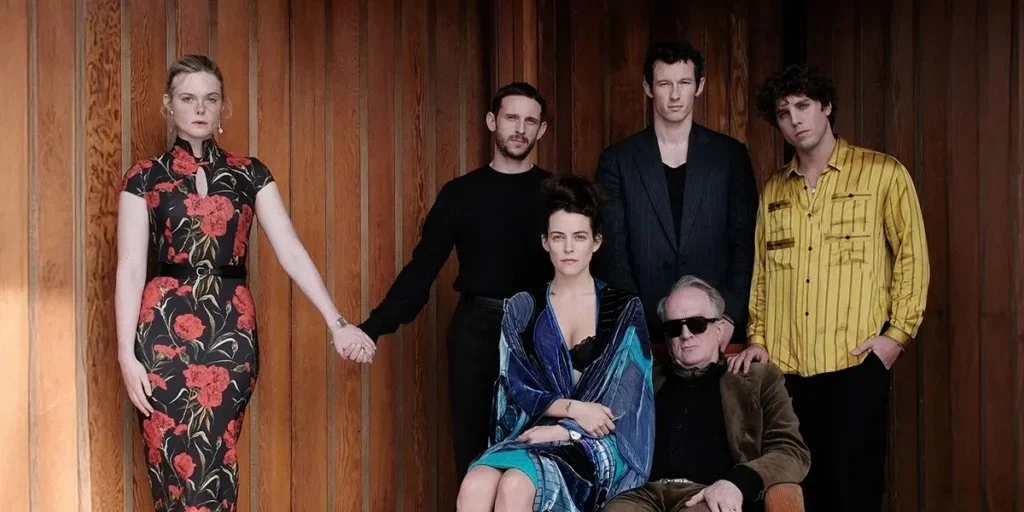
Rosebush Pruning. MUBI
For the Austrian designer and architect Friedensreich Hundertwasser, the straight line was to be considered “godless and immoral.” Nature works in curves, deviations, and spirals; the design of rigidity is man’s attempt to impose an order contrary to—constraining—the transcendent. Hundertwasser’s declaration is embodied most emphatically by the designs of Antoni Guadí, whose works in Barcelona revel in spiritual, evocative swerves. Walking through Park Güell, the Sagrada Família, or Casa Milà, the bold, bright materials function almost as a sensual assault on the eyes.
Karim Aïnouz takes note. His film Rosebush Pruning, conveniently set in Barcelona, also functions as a visual assault. Rosebush Pruning bursts with primary colors, as the titles and early images resound in reds, yellows, and blues that virtually scream at the audience. Like the work of Gaudi, it’s intensely expressive and unsubtle—a rupture of flattened mundanity, the commonplace. But Gaudi had a point to it all. Does Aïnouz?
The scream is a motif that carries through the film far beyond the spectacle of its primary colors. Rosebush Pruning sketches the downfall of a wealthy American family now living in Spain. They are so wealthy that they really have nothing to do, and they never have. Their entire lives have been marked by such boredom and ease that it has disfigured them into characters that are hardly more than Freudian fixations. The father (Tracy Letts, who deserves so much better) is controlling in his opinions, entirely self-focused, and suffers from blindness—subtle enough? The mother has died, torn apart by wolves, or so claims the father. As for the children, they are a hodgepodge of psychosexual deviances: When he’s not arbitrarily hitchhiking, Ed (Callum Turner) is the voyeur of the family, observing and commenting on the others. Anna (Riley Keogh), the only woman and manipulator, twists everyone in knots. Robert (Lukas Gage) lusts the most openly with an incestuous desire that extends well beyond his control. Then there’s Jack (Jamie Bell), who’s supposedly “the most normal,” though clearly far from healthy.
The word shallow wouldn’t fit these figures, as shallow implies a depth that resides somewhere, if not here. Facade implies a whole structure. The nature of these characters is pure surface: a veneer covering a nothingness. Gaudi is mentioned offhand only to declare that Ed is more interested in Balenciaga. Indeed, the biggest words these characters know are the names of Italian and French designers which they love to invoke as though saints. And certainly this is part of the critique of Rosebush Pruning: Look how distorting and empty this amount of wealth is. See how it evacuates all human nature, leaving merely the direst forms of greed and lust as the resources to form a personality.
The issue is that the narrative and style are (nearly) as void as the family. The last couple decades have provided a surfeit of eat-the-rich movies, from the excellent and insightful (Parasite) to the misguided (Saltburn), from the winkingly schlocky (The Menu, Ready or Not) to those with delusions of import (Triangle of Sadness). These movies aren’t coming out of nowhere; clearly our society—or at least our moviegoing public—is feeling antsy about the widening of wealth inequality. But out of this abundance, Rosebush Pruning finds nothing new to offer, only the queasy spectacle of astronomically affluent freaks and their fetishes. If you like being made to watch Freudian complexes made absurdly literal onscreen, have at it. On the other hand, there’s plenty of evidence for wealth’s deforming influence readily available in daily news; Rosebush Pruning isn’t unmasking anything we aren’t familiar with.
At best, Aïnouz’s film questions whether every unfathomably wealthy family is doomed to become a Dogtooth of its own making. It’s fitting then that Dogtooth’s writer also penned this script (based on Marco Bellocchio’s 1965 Fists in the Pocket). Efthimis Filippou, who has primarily worked with Lanthimos on that film and The Lobster, The Killing of a Sacred Deer, Kinds of Kindness, and Alps, never allows the characters to become more a few quirks or entangles the narrative situation into something more interesting. The most refined metaphor at play is wolves hungry to tear apart flesh—a choice with the subtlety of an all caps social media post. Lanthimos’ oddballs are here in a sense, but the saturating weirdness is nowhere to be found, and Rosebush Pruning certainly never forms any cultural critique that Lanthimos’ (earlier) work strives for.
Everyone in the family is a bad actor, and it’s tough to tell if the cast is doing much better. The standout is Elle Fanning, playing Jack’s girlfriend, who provides the only external view of the family. In some ways she serves as an audience surrogate, but she doesn’t necessarily fare much better than Jack’s family in terms of depth. Ed serves as our ill-suited guide, giving a voice-over that seems unmatched to the film. It’s lumpen, not serving a clear purpose other than to reiterate what’s already obvious. Jamie Bell is fine, though nothing more.
The characters, the visuals, and even the soundtrack are all garish, but there’s little underneath the burst of color. A flashy brand name-drop concealing the lack of personality. Sexual desire alienated from any relational significance. It’s fine for the characters to be just as animatronic as the iron deer outside their home. What’s damning, however, is that the entirety of Rosebush Pruning is just as lifeless.