‘Mother Mary’ Gives Texture to Modern Mysticism
A24
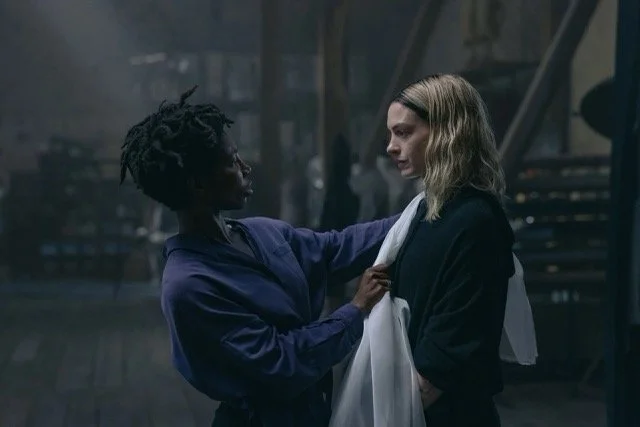
David Lowery’s mystical Mother Mary is suffused with textures of all sorts. The protagonists of this tale are distinguished by texture: the pop star known as Mother Mary (Anne Hathaway) takes the stage with all manner of dazzling costumes, whereas Sam Anselm (Michaela Coel), Mary’s former dress designer, is surrounded by reams of fabric in stunning tones and textures, some silky, some thick, all communicating a sense of how they would feel grazing your hand across them.
The worlds of Mary and Sam are composed by different fabrics in and of themself. Mary is awash in stage lights, makeup mirrors, and the glow of modern pop stardom. Hers is a shiny world, a surface world, a world also at the top, at the front of people’s mind. It’s a world where Mary is the gravitational core, pulling others toward her in the rush of fandom. The texture of Sam’s world, on the other hand, feels lost to time. She runs a successful design studio—one that bears her own name as the genius behind the work—but she inhabits a large stone manor that makes one feel exposed and chilled just seeing it. She herself cheekily acknowledges it: “I’ve entered my Miss Havisham period.”
The texture of time burdens both of these characters, its presence thick upon their shoulders. Sam and Mary used to be close, united, their shared creative projects seemingly seamless and inseparable. So when Mary left her behind for other designers and creative partners, Sam felt like she had been sheared off and discarded. Bitter and devastated, Sam refused to listen to Mary’s music anymore, doing her damndest to put the cursed past behind her. It works well enough for a while, but after a frightful accident (and possible attempted suicide) at the climax of a concert, Mary bursts back into Sam’s stony world demanding a new dress.
Throughout his filmography Lowery has refracted varied stories of myths, legends, and icons. It began in earnest with 2013’s Ain’t Them Bodies Saints (a reworking of Bonnie and Clyde), and the project has expanded to include legendary figures such as Peter Pan, Gawain, and Robert Redford, himself. Another core spirit of Lowery’s work is the creation of worlds that upend their characters’ expectations in strange, unexplained ways. Mother Mary deploys both skillsets with self-confidence. The thing that haunts Mother Mary refuses to fade quietly into the night, cutting beneath the surface of her star persona to interrogate the hidden wounds such fame has papered over.
In Lowery’s hands a world that is more familiar, more grounded than Neverland or King Arthur’s court is nevertheless shot through with a sense of the mystic. Make no mistake, Mother Mary is succumbing to a haunting in a very physical sense. As modern and rational as the world of pop music may appear, Mother Mary infuses it with intricate religious symbolism. First, and most obviously, with the title itself, which orients the popstar’s onstage persona. Every costume includes a halo, be it radiant and golden, shiny black, or a masochistic corona of nails, and her biggest hit song is “Holy Spirit.” Sam propels just as much iconography at the audience: she recalls a costume that made Mary look like Joan of Arc and she recalls her first Communion. Her name, too, is loaded—it hearkens to Saint Anselm, the eleventh century theologian and philosopher who outlined arguments for the existence of God.
It is precisely this sort of enchanted, occultic world that Lowery revels in realizing. The dreamlike pans and rotations of The Green Knight develop here into imagery that, while more technically restrained, pack just as much of a punch for the fact that this world shouldn’t be so mysterious. The specter that haunts Mary and Sam alike manifests as—as what? A shade, unspooled fabric, a dress? The specter glides through the dark as a diaphanous crimson and, when it reveals itself to Mary during her concerts, is adorned by a perfect circle of red. Perhaps forming a head, a signifier of identity and communication. Or perhaps a mirror of Mary’s halo. There are various sequences that visually stun and that alone would make Mother Mary worthy of note. Lowery envisions a Sisyphean cycle in which Mary descends the stage only to climb back up for the next show, staircase after backstage staircase revolving into frame.
But the most vibrant fabric of the film is Lowery’s script, a sly work of asymmetry in this two-hander. While there are ample visual thrills stitched through the runtime, the most significant portion of the film takes place at Sam’s home, following a couple of extended conversations between Sam and Mary. The intricacy shows itself in how the two actors embody entirely distinct presences in Mother Mary: Hathaway is nearly entirely a physical force. For a long time, her lines are short and crisp—”I need a dress.”—and she’s frequently shown in close-up without saying a word. It’s all reaction and emotion that expands into movement, a rendering of the body as the site of pain and weariness and guilt. Her most impressive scene involves a silent dance, where the only sounds are the heavy thumps of her feet and sharp exhalations of effort.
Coel’s Sam, conversely, lets loose a deluge of words. The verbal force of the film all rests with her, and Lowery’s script gives her an abundance of wit and clarity to work with. The dialogue (frequently verging on monologue) is layered, brainy, and gymnastic, and Coel savors every single word. Every reflexive response is transmuted into a verbal parry that also exposes her own wounds. Just hearing her turn over “carcinogen” in the opening moments cues you into how she’ll approach later lines. “We await the day of our Pentecost,” she proclaims, and you can nearly feel the spirit descend with her very utterance. Hathaway is strong, but Coel is a revelation in Mother Mary, giving a vocal performance of breathy murmurs and vaulting accusations. It’s a voice that commands, that conjures, that encroaches.
Mother Mary unfolds the ecstatic texture underneath our modern obsessions, whether those of pop iconography or the relational fixations of fragile people. Lowery layers the symbolism, envisioning the pop star as a modern religious icon, performance as possession, exorcism as reconciliation, and music as a form of transcendence. But as Lowery knows better than most, not every encounter with transcendence is a welcome one.