Bi Gan’s ‘Resurrection’ is a Delirious Journey
Dangmai Films
There are few ways to conclude a movie that are as frustrating as revealing that all or many of the previous scenes have actually been the protagonist’s dream. It’s a cheap and flaccid way to conclude what often is an engaging story. Rarely does it work on a narrative level, leaving you feeling as though you’ve been cheated. But behold a movie that inverts that: everything after minute twenty five is explicitly framed as the protagonist’s death dream. And what a wild dream it is. Welcome to Bi Gan’s Resurrection.
Good news or bad news first? The good news: Humans have realized the key to unlocking eternal life. The bad news: The key is to refrain from dreaming. The opening intertitles tell us that, by never dreaming, people have become “like candles that do not burn.” Yet the very first image is one of fire eating away at the screen. The words and the images are already in conflict, much like the world this film takes place in. Some people in this world refuse to release their clutch on dreams, leaving them susceptible to decay and death. But that’s not enough for the forces in power; they send agents to track down such “Deliriants” as they’re known. Better to remove them from society before they can have unwanted effects on those around them.
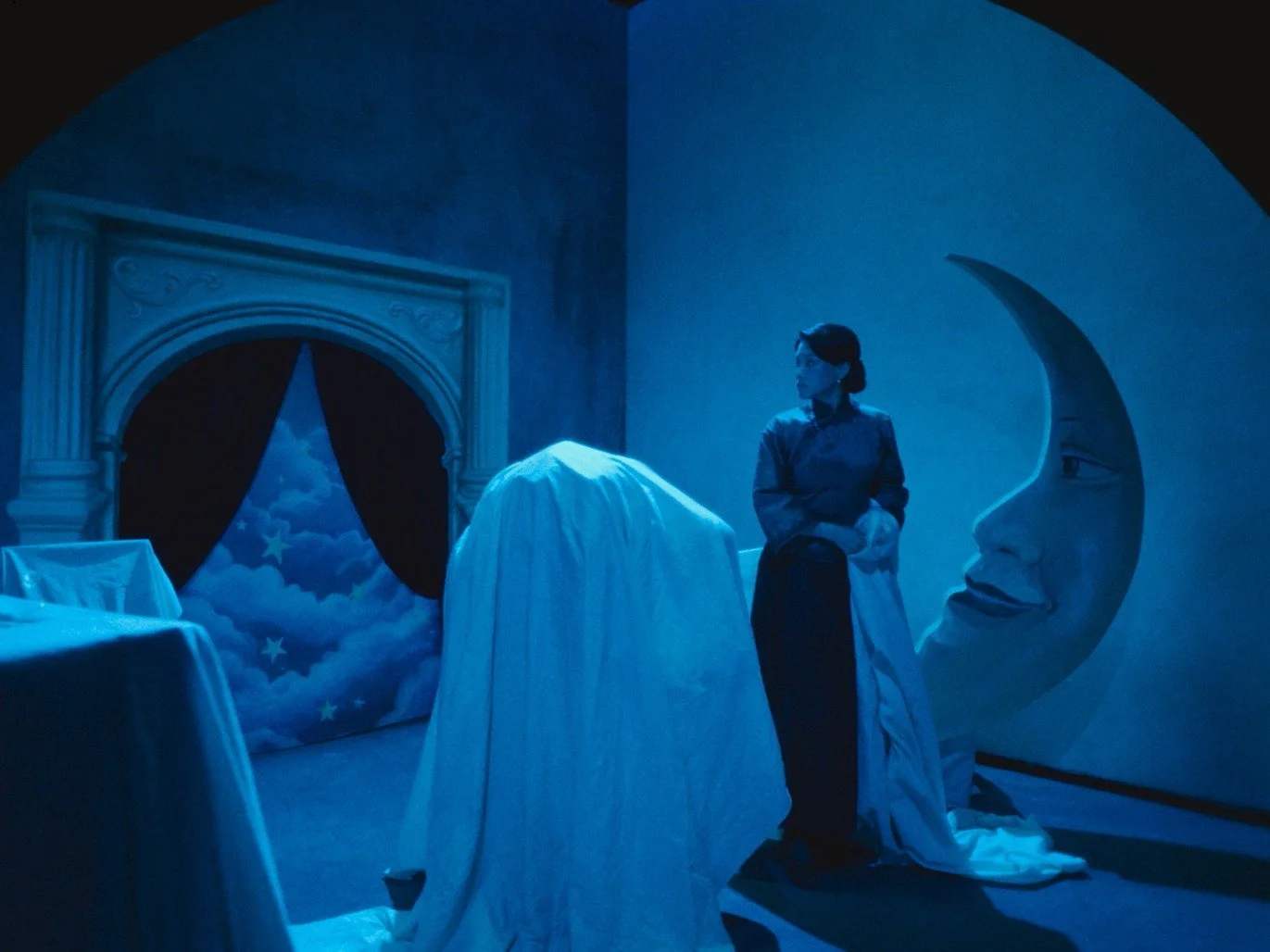
To make matters worse, the prohibition against dreams includes watching a film. After all, what are movies but waking dreams, sensory experiences that transport us elsewhere until they conclude and deposit us right back into our world? As Resurrection opens, one government agent (Shu Qi) is tasked to track down a Deliriant who has retreated almost entirely into movies, seeking pleasurable escape while his body deteriorates. The opening section of Bi Gan’s film follows her investigation into an opium den where she eventually locates the Deliriant (played under heavy prosthetics by Jackson Yee) who, by this point, has deformed into a monstrous creature evocative of the hunchback of Notre Dame or Nosferatu. As a matter of fact, the latter reference point goes beyond just the character design—the agent’s investigation plays out in silent film fashion, with numerous nods to German expressionism. As she descends deeper, Bi begin to deconstruct and reconstruct the art of cinema itself. A giant hand peels away a portion of the set, revealing a new location underneath. Then the set itself begins to rotate, clearly drawing attention to the theatricality of its arrangement. But if the artifice is obvious, it in no way dulls the moment. The excitement here is precisely watching Bi comment on and reuse classical moviemaking forms.
The opening section is instructive: this is a movie that uses movies to theorize about movies. The first thirty minutes include homages to Nosferatu, The Cabinet of Dr. Caligari, and the works of Méliès and Lumière. The next section will make clear reference to Orson Welles’ The Lady from Shanghai (along with a more atmospheric evocation of Kiyoshi Kurosawa’s Cure). You better find all of the narrative material you need now, because you’ll be leaving it behind in a short time. The agent eventually captures the Deliriant and remorsefully condemns him to death via movies. When she discovers that his body is actually contorted by a projector on his back, she loads a reel of film and flips the switch. Watching the reel play out will be his final act, but it will also “prolong the dream for one hundred years.”
What transpires next are his dreams, which themselves form a survey of cinema’s history and genres. Yee, having shuffled off the monstrous Deliriant coil, will show up in the segments as a mysterious murder suspect, a former Buddhist monk, a no-good con artist, and a bleach blond street hustler looking for love. Do not seek the narrative throughline, or even a persistent dream logic. As Resurrection progresses, it moves like the remnant memories of the dreams you’ve gathered over the decades, stitched together in cellophane.
The next section is a wartime noir suffused with midnight blue. Like many of the best noirs, it’s unclear whether this world ever experiences daylight. A murder has occurred, and Yee’s Qiu Moyun is the prime suspect. The victim was stabbed, but it also seems like the victim stabbed himself in the ear drums after mumbling something about embracing silence to hear his voice. The young man Qiu is apprehended, tortured, and interrogated, but the investigator (Mark Chaso) is stymied. Tracking Qiu’s path the investigator finds sheet music and eventually a theremin, but he might just fall prey to the same fate as the victim.
The opening, with its playful recontextualization of silent cinema (or, as Michel Chion would call it, “mute cinema”), excites the sense of sight. The noir episode questions the sense of sound, and perhaps ferries us chronologically into the advent of “talkies.” Adding sound to cinema would seem to obviously be an addition. But when silence departs, what else is lost? We’ll never know, because it’s time for the third segment.
Yee is now on a work crew when his coworkers leave him at a Buddhist temple overnight. He’s initially plagued by a toothache, then plagued by a spirit of bitterness who adopts the figure of a man (Chen Yongzhong). They have a long discussion where the spirit instructs Yee to find the bitterest stone by taste—our next structuring sense. At this point Resurrection rapidly loses steam, releasing the visual playfulness of the prior segments without finding thematic purchase. The next section fares a little better, with Yee as a con artist looking to gin up enough cash to get out of town. In order to do that, he teaches a young girl how to cheat at card tricks, pretending to be able to smell the identity of each card. Thematic clarity is somewhat regained: We look to movies to provide illusions that satisfy our cravings. Sometimes they do so, but sometimes those illusions affect us in ways we weren’t prepared for.
The final section replaces the noir’s blue tones with blood red hues. If we’re keeping track at home, we’re left with the sense of taste, hinted at when Yee’s young man encounters a girl during the final hours of 1999. Awaiting the new millennium, they trade secrets. “I’ve never kissed anyone,” he says. She ups the ante: “I’ve never bitten anyone.” Bi adopts a genre for this segment that allows for kissing and biting to both make fitting reappearance. And hey, the shoe fits here, too. If vampires represent the living dead, doesn’t cinema enact a somnambulant life? But the true thrill is in how Bi unfolds this entire thirty minute stretch in a single tracking shot, veering through city alleyways, setting the stage for fight scenes and gunplay, and eventually ending on a peaceful barge as the couple drifts into the sunrise.
The dream must end eventually. Doesn’t it always? The credits usher off the images, and return the audience to their present world. Whatever one makes of its ideas, Resurrection offers a delirious journey, where every frame is a dreamscape and every image a story unfolding on its own. Even as it takes celluloid to be its flesh and the history of cinema as its haunting spirit, Resurrection is the most sui generis film I’ve encountered in years. This is film as entrapment and liberation all in twenty four frames a second. But are the images more substantial than the whole of the film? As the credits rolled, that’s the sense I was left with. It never quite crystallizes enough feeling or clarity for me to have a definitive response to it. I tasted its liberation, but I also caught a whiff of its entrapment.