‘Project Hail Mary’ Is Fueled by the Force of Gosling’s Goofiness
Amazon MGM
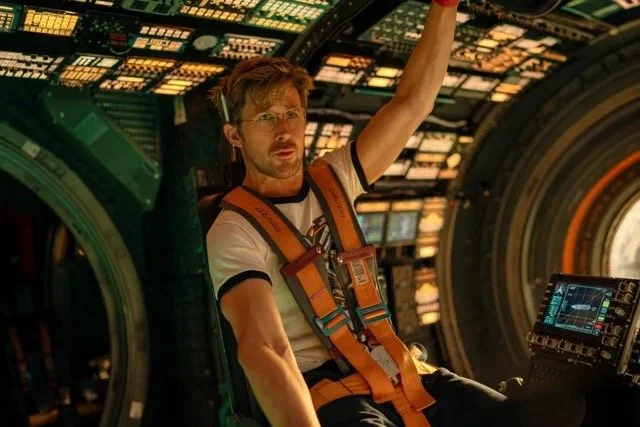
Project Hail Mary is full of grace. Full of Grace, that is. Ryan Gosling’s Dr. Ryland Grace (I am only now noting the echo of initials) fills just about every moment of the movie’s two and a half hour runtime, and in many of these scenes he’s all alone. It’s a lot to place on one actor’s shoulders, but few have solidified their ability to sustain attention through sheer goofy charisma quite like Gosling. Even for those unfamiliar with the work of Andy Weir (who wrote the original novel as well as The Martian, which was also adapted into a film), familiarity with Gosling’s comedic sensibility will be enough to offer delights and amusement in Project Hail Mary.
Working from a script that Drew Goddard (who also wrote the screenplay for The Martian) adapted from Weir’s novel, Phil Lord and Christopher Miller (The Lego Movie, 21 Jump Street) jettison Dr. Grace into the farther reaches of space on a last ditch mission to save humanity. The sun is dying—dimming, to be precise—its energy being sapped by the mysterious Petrova Line. Scientists have discovered the infrared light generated by this strange cosmic occurrence, but the Petrova Line’s origination and effects baffle the world’s knowledge. When Eva Stratt (Sandra Hüller) shows up in Grace’s classroom representing a conglomerate of the world’s government, Grace’s molecular biology expertise enables a breakthrough. The Petrova Line is composed of bacteria (coined Astrophage) that feed on the sun’s radiation.
An exciting scientific breakthrough—that also outlines the impending death of human life on earth. Much to his dismay, Grace is roped into the skeleton crew mission to a far sun, the only known star that isn’t being consumed by the Astrophage, in hopes that the answer can save the earth’s sun. The outward journey alone takes eleven years, and Grace wakes from his induced coma to find his crewmates dead. Now he’s all alone, struggling to collect his memories and solve the riddles of this environment.
Thankfully for him, it turns out he’s really not alone at all. An alien life form, resembling a boulder with arms, introduces itself. It quickly becomes clear that they are both here for the same purpose, so Grace befriends the creature that he affectionately names Rocky. But before they can solve the galactic threat, they first have to understand each other.
From here on out, Project Hail Mary takes the form of a buddy comedy, and this is really its nature far more than a space movie. As a buddy comedy, it’s an easy sell. On one hand you have Rocky (eventually voiced by James Ortiz): the anthropomorphic geode resides solidly in the cute-cloying genus of cinematic aliens, somewhere in the family tree of Stitch and Groot. He’s just as intelligent as Grace, though his grasp of English idioms leads to humorous misinterpretations, and he’s a little bit clingy—he has been all alone in deep space for a long time, after all. So he’s thrilled to have a new friend. On the other hand you have Gosling as Grace, putting on his best witty fool persona. Gosling has been honing this precise charm across the previous decade through The Nice Guys, Barbie, and the SNL Papyrus skit. By now, he can do this in his sleep. And even though there are moments in Project Hail Mary where I suspected that might just be the case, his skill with this sort of material never fails to entertain.
It’s as a space movie that Project Hail Mary is found wanting, though. You can’t make a space film without being in dialogue with all of the totemic forerunners, of course, but Project Hail Mary feels like a rushed diorama of influences that never builds on those respective ideas with any ingenuity. There’s a sequence of spinning spacecraft accompanied by a playful classical composition (à la 2001’s Blue Danube sequence)—almost a requisite inclusion. The plot device of a suicide mission to resuscitate a dying sun loudly echoes Danny Boyle’s Sunshine; Grace’s awakening from a coma and slow mania alone in space sees Gosling paying homage to Sam Rockwell’s excellent work in Moon. The introduction of Rocky moves the film into Arrival territory, though it (too) neatly jumps over all the linguistic challenges of that film. And Rocky’s ship resembles the black hole tesseract from the conclusion of Interstellar, with its brown-hued rigid lines simultaneously rendering space as a rebar-filled construction site and also a portal through dimensions. Perhaps the most revealing flaw in this side of Project Hail Mary is leaving Grace’s ship unmapped: usually a crucial part of space movies, no time is spent on it here, at all. In the end, it doesn’t matter for you to know how the spaceship (or the imagined science) works or where crucial components are located. What matters is the pacing of the script’s jokes and the opportunity to see Gosling perform a solo slapstick show.
While the emphasis of the film is on the camaraderie between Grace and Rocky, it’s the earth sections that actually build the most character development. Gosling’s goofiness is most pointed when met with Hüller’s stonefaced replies—I am excited that Project Hail Mary will introduce wider audiences to one of the most skilled actors of recent years. The cute alien creature always sells, but it can only go so far in creating an engaging, immersive world.
Project Hail Mary is a blast, a popcorn flick of the purest form: a tight script, a smart sheen, a self-deprecating silliness, and a strong central performance. But I anticipate it will also be rather forgettable. It hits its target, but it never aimed that high, after all.