Corporate Culture Gets Reamed in ‘No Other Choice’
No Other Choice. Moho Film
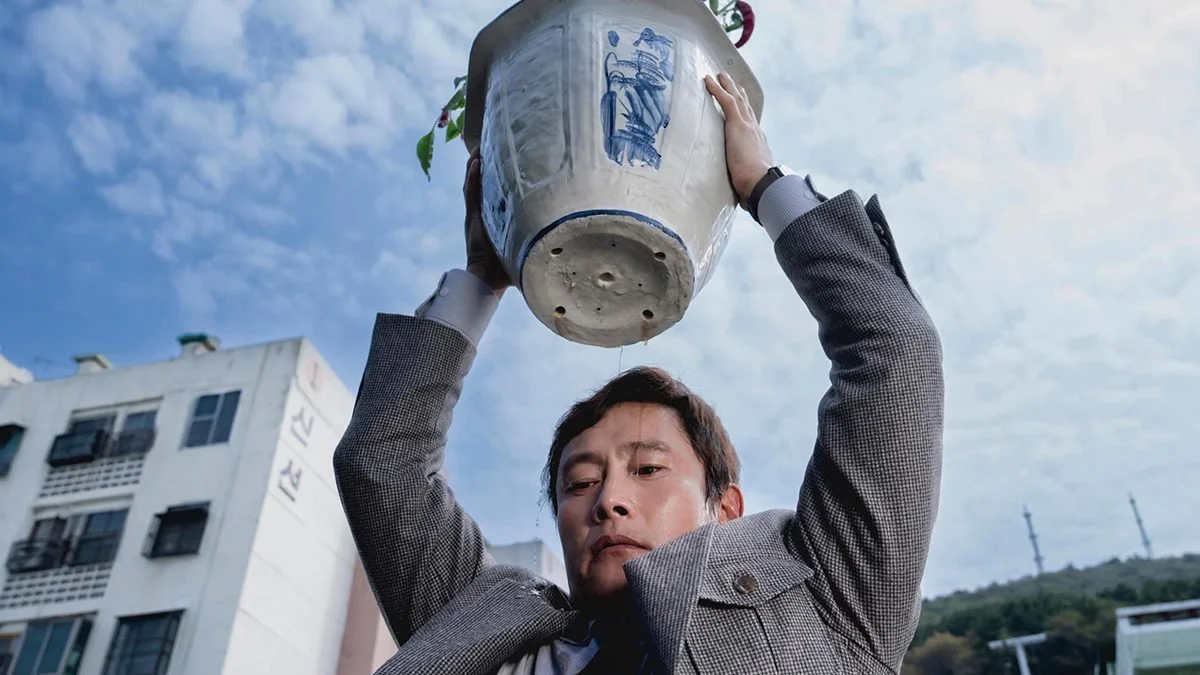
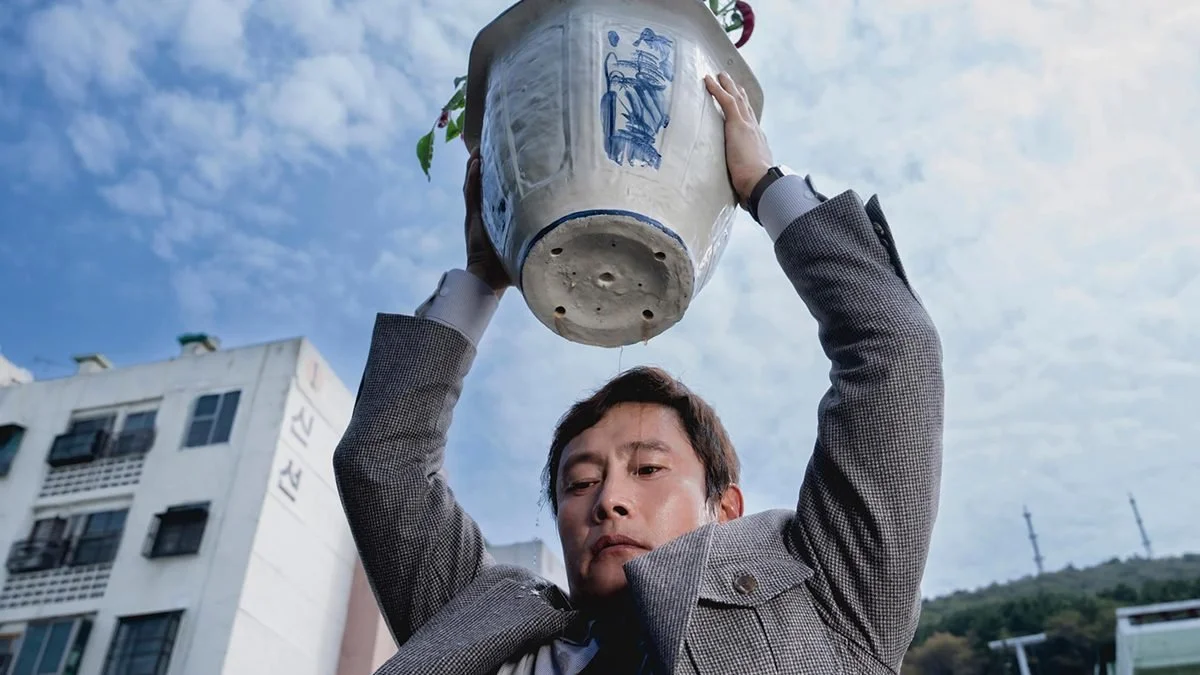
There’s a sign at Yoo Man-su’s (Lee Byung-hun) paper factory that reads “Stop. Think. Act.” Looking beyond its corporate positivity, though, one could imagine a more apropos message: Abandon all hope, ye who enter here. To be clear, Solar Paper is not a special domain of Hell—rather, it’s the entirely typical, familiar space of big business. Solar Paper. Moon Paper. Pacific Paper. The companies are as visibly bare and interchangeable as different sheets of white, A4 printer paper.
So while the opening of No Other Choice waxes romantic, with cherry blossoms gently wafting from branches and an overly lush depiction of a perfect Korean family—dad grilling outside, daughter practicing her cello, son on his phone, dogs running around the yard—it doesn’t require the most careful of interpretations to realize that this fantasy is going to be shattered. Park Chan-wook (Oldboy, The Handmaiden) wants to make that irony clear. No Other Choice is an open satire, more goofy than tense, more winking than subversive. The fun isn’t so much in following a mystery as watching Park deploy technique after honed technique to layer imagery, script, editing, and performance for the film’s aims.
Narratively, No Other Choice is something like Parasite in reverse. Based on the novel The Ax by Donald E. Westlake (which was previously adapted for the screen in 2005 by Costa-Gavras), No Other Choice follows its sentimentalized opening with Yoo’s sudden, arbitrary firing. One moment he was an achiever—Pulp Man of the Year—but the next he’s joining the ranks of the unemployed. When the new American partners suggest changes to increase efficiency, Yoo sees through the ploy: “You want me to put a gun to their head?” What Yoo can’t see coming is that they consider him equally expendable.
He also can’t foresee how literal those words will become. Despite the grand moral claims of Yoo and other established corporate employees, the system practices are powerful enough to reduce them all to being crabs in a bucket. So after Yoo strikes out with the scant open positions he applies for, he decides to follow that workplace mantra. He stops. He formulates a plan. And he acts. And by “acts” I mean “murder his competition,” or at least attempt to.
The script is intricate, and individual scenes rarely play out predictably; there’s a persistent twisting and subverting of tension that runs throughout. No matter how successful Yoo is, however, his achievements are tenuous and temporary. Because the clear truth is that the system is never going to come to its senses. It is not human, after all. It doesn’t possess senses as we do. It can’t feel regret, compassion, or humility. It can only mechanically chase the goals it was designed with: efficiency, productivity, enlargement, market dominance. These goals hardly have space to notice the plight of the individuals caught in its gears.
While No Other Choice doesn’t break new ground thematically or narratively, it is purely a creation of Park’s dense, calibrated style. There are few contemporary filmmakers who bring such electricity to their choices of edits and transitions—this is style without any sacrifice of substance. The camera takes its cue from the cherry blossoms as they dance in the wind. Or the rain against a child’s bedroom window is suddenly wiped away from Yoo’s windshield, wittily crosscutting between the characters and locations. There are a dozen more I could point out and twice as many that I hardly had time to notice.
Park even weaves cross-lingual jokes into the dialogue. (For example, the children are named Ri-one and Si-one. In Korean, of course, they aren’t pronounced like the numbers in English. Except: the dogs are named Ri-two and Si-two.) And again, there’s even a knowing play in the protagonist’s name. He is you, he is every man, a representative of the corporate species. Lee’s performance is restrained in dialogue, but injects a cartoonish physicality that fits the silly mishaps Yoo gets himself into.
In Park’s later films, no detail is left behind. Every line of dialogue (including the title) recurs and either adds or inverts meaning. Every insert shot promises to become a motif or a narrative hinge. He is the current king of juggling details within both the narrative and the style of the movie. No Other Choice unabashedly continues this trend, though it slouches a bit due to its obvious ideas. Park’s previous film, Decision to Leave, had a similar ball with editing and script, but that narrative formed a twisting, lovely dance where the next step was all but impossible to predict. No Other Choice doesn’t reach those moments of ecstasy, but it is still a fun exhibition of satirical style from a director with a massive toolset.