Absorbing Performances and a Probing Script Energize ‘The Invite’
Annapurna Pictures
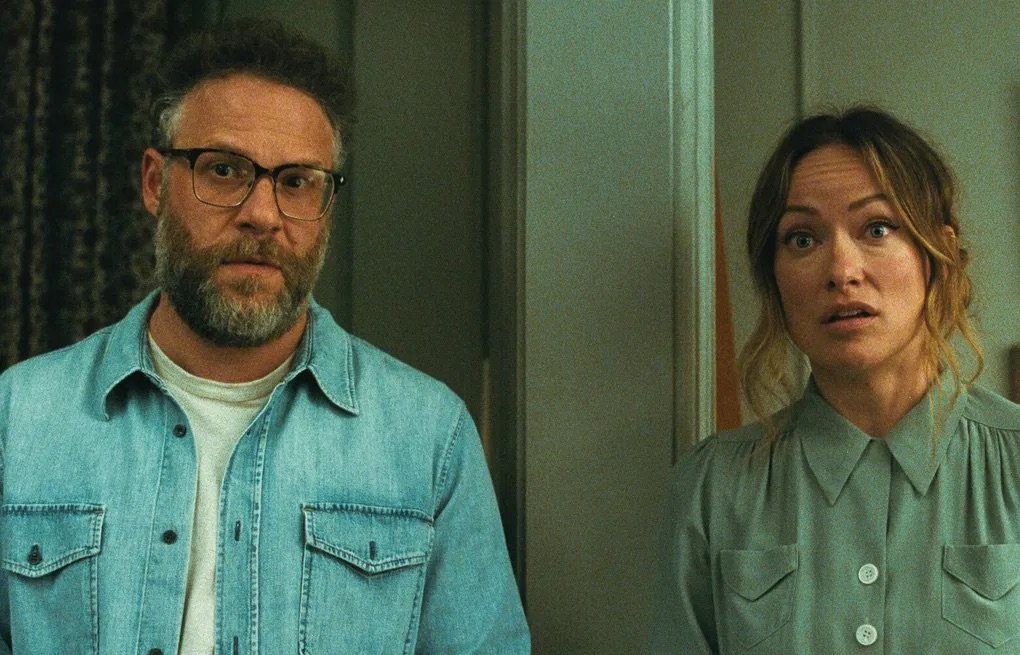
The opening notes and opening credits of The Invite act as a guide for engaging with the rest of the movie. As with many moments of Olivia Wilde’s latest, these are sharply crafted and isolated distillations of the broader ideas. First the notes, heard without corresponding image: We hear Rogen’s voice and Wilde’s laughter as a snippet of song is played on piano. A few notes are struck, then a pause, then another effort. This is a couple trying to synchronize. The credits then drive a contrapuntal force. Wilde’s Angela and Rogen’s Joe are shown in the labors of their day, while black negative space surrounds them, limiting them to small fragments of the screen. These characters will constantly be framed in spaces that crowd or isolate them. The black boxes through the credits are the most overt form of this, but lentils, window panes, and mirrors will inherit this function through the rest of The Invite. Already Wilde is conveying a sense of isolation and separation—obstacles to synchronization—and indicating the act of framing, of arranging and casting a person in a certain angle.
Joe and Angela are a typical couple who have gradually settled into an increasingly small and life. They live in San Francisco, in a condo inherited from Joe’s parents, and have a daughter, Maggie. Joe is a music instructor at a small conservatory in the East Bay, and Angela has an Arts degree that she hasn’t done anything with in a decade. And they have no friends to speak of. Save for their love for Maggie (definitively the most unifying between them), any one of these things is a source of unspoken frustration for the couple. Despite sharing a home and a life, Angela and Joe feel separate. When Joe returns they enter into bickering before even getting to mundane pleasantries. Joe seems to prefer to keep to himself, but keeping to herself seems to be driving Angela up the wall.
This last point is the impetus for Angela inviting the upstairs neighbors over for a dinner party (which she may or may not have told Joe about ahead of time). They don’t really know them. They’ve white knuckled their way through small talk in the elevator, they’ve glanced at them through windows that unfortunately give the upstairs apartment a view right into theirs. And, well, they’ve been kept up late at night by the frequent and unbelievably intense sounds of sex coming from above. It’s invasive to the point that Angela and Joe wonder which one is the growler.
The tension in Angela and Joe’s home is high enough before the neighbors, Piña and Hawk (Penélope Cruz and Edward Norton), arrive. The Invite, with a script by Rashida Jones and Will McCormack (who also scripted Toy Story 4 and Celeste & Jesse Forever), is an adaptation of a Spanish film titled The People Upstairs. It maintains a stressful comedic tone throughout, but Wilde’s film has as much in common with Before Midnight or Ingmar Bergman’s Scenes from a Marriage as with any outright comedy. Joe and Angela manage to temper their tempers only briefly and unconvincingly, but that’s okay—Hawk claims that they “love a contentious environment.” And the four will proceed to not so much stumble as plummet headfirst into every social taboo.
What Hawk and Piña love will serve as a provocative mirror to Joe and Angela. The mirrors which proliferate throughout the shots of the film are telling, but it’s as much a narrative gambit as a visual motif. The upstairs couple seems carefree and adventurous (and how), in stark contrast to the hosts. Joe is too demure and begrudging of having to interact. When tequila shots are passed around, he stands off from the others, ignoring the toast and jumping the Salud. He aims for subtle stabs that aren’t all that subtle, and that are mostly directed at Hawk (“there’s worse birds”). Angela falls on the opposite pole, hyperactive and overeager to please. A shot of Joy of Cooking as she bakes a soufflé is a joke at her expense. The idea of a well constructed, happy life is what motivates Angela, but she derives no joy as she attempts to manufacture every aspect of it.
The Invite plays as a chamber piece—Who’s Afraid of Virginia Woolf? seems another clear reference—and its vitality lives primarily in its script and performances. (This is not to downplay the blocking and cinematography, which is always dexterous and effectively composed.) The most enticing draw of the film is getting to watch these actors handle these quips and dialogues. Everyone is potent, and each piece is crucial, because The Invite understands the dinner party as a scene of constant triangulation of others and ourselves. Cruz is all energy, sparking different desires in Joe and Angela. Joe’s is obvious; Angela seems to see a version of someone she would like to be, or at least like to impress. Norton, who’s always been a talent, has been on an irreproachable tear of supporting performances in recent years: he’s tapped into tech bro idiocy in Glass Onion, contributed an emotional power to Asteroid City, and imbued A Complete Unknown with a comforting turn as Pete Seeger. It feels as though he spent the past decade studying the actor Edward Norton, learning every one of his tics and minute expressions, and has learned to control each one for whatever the project calls for. Wilde takes on the biggest and toughest performance, landing somewhere between Katharine Hepburn’s screwball spirit and the cringe comedy impulse of regretting something as soon as it’s uttered. Rogen is the standout for me, however. It’s not just that he can twist from annoyed to amused to self-absorbed to emotionally wounded on a dime; it’s that he makes those twists persuasive as Joe. Rogen’s jabs while lying in pain on the floor is simultaneously the funniest scene and perhaps the most poignant moment of performance.
Speaking of twists, yes, there is a minor “twist” in the story—though the trailers do everything shy of stating it, and the film doesn’t depend on its secret. As the open conflict crests, Hawk and Piña confess to throwing sex parties in their upstairs apartment. Joe and Angela’s ire at the noise is almost immediately overwhelmed by erotic curiosity. The film forays into a very blunt and explicit conversation regarding the procedural logistics of these sex parties. For the stuck-in-the-rut couple downstairs, this wild adventurism tantalizes. Is their lack of sexual experimentation what’s been limiting them so much, what’s kept them from living expansively? Is that why Joe’s so miserable and Angela’s so exasperated? Alas, even in their attempts to grasp at new desires, they can only return to themselves.
It’s in the twisting (not the twist) of the narrative that the film stumbles. The script is arranged somewhat into distinct acts: an abnormally confrontational party, a cards-on-the-table discussion of sexual appetites and how they affect other personal desires, and an impromptu therapy session. In each section the script is dense, surprising, and exhilarating, but the transitions between them feel clunky, jarring. The scenario pivots from one act to the next in ways that are at odds with the characters and conversation. And the biggest flaw of the script is to make Piña a psychotherapist so that she can, without warning, sit Joe and Angela down and probe them about their relational failures.
This last act is clearly the heart of the film, as Joe and Angela are forced to confront the ways their own choices have isolated themselves and framed the other. Angela describes their home projects as “renovation without change,” and this always characterizes their marriage. They’ve evaded necessary changes, instead attempting to make small adjustments through pointed comments and incomplete communication. The scene is charged and on target, but the contortions to get there aren’t convincing. Still, The Invite is a precise interrogation of relational stagnation that evokes its fair share of laughter and wincing, alike.