‘The Odyssey’ Delivers Massive Spectacle (If Scant Surprise)
Universal Pictures
A black figuration of a horse rises askew from the sand, half buried by the tides. Front hoofs arch upwards, as though the creature is panicked and frozen in an attempt to dig itself out. Its dark surface is unblemished, but it rests alone as though a monument forgotten to time eons hence. Elsewhere, in a dark room only sputteringly warmed by torchlight, a man thumps his stick and begins to chant a refrain, a story of “a face, a fleet, a war, a man, a thought, a trick.” Before his tale can unfurl, however, Penelope’s (Anne Hathaway) voice rings out: “Not this song!”
This is how Nolan frames his rendition of Odysseus’ tale. It is an interrupted tale, threatened (fittingly) by two monstrous possibilities. On one side of the thin channel of time is the threat of becoming forgotten, that the ages will have spawned tales that supersede Homer’s epic, and that such adventures will fall into history like Ozymandias’ power. The other peril is its opposite: to remain familiar to the point of drudgery. That people will merely tire of hearing this tale and opt for other stories by way of choice.
Homer’s tale has avoided these diametric fates. Here on the vanguard of the twenty-first century, we remain caught in the whirl of Odysseus’ encounters with gods and men and nature. It’s somewhat miraculous, isn’t it? Surely we would’ve exhausted our fascination with the Odyssey by now, over 2500 years since it was first composed. But we haven’t. We keep circling its seas in a longing to glean insights and inspiration alike. Insights about ourselves, as we look inward. And inspiration about our world, casting our gaze over the horizon.
Every new Nolan film is an event in its own regard, and there is no filmmaker better suited to tackle an epic of this nature in our current movie era. (The only other one who could fathomably take such a massive swing is in the middle of his own sandy epic on Arrakis.) And there’s enough connective tissue to the rest of Nolan’s filmography to understand his desire to stage this journey. There are numerous motifs that run through his films—men, racked with guilt, trying to get home; protagonists desperately trying to piece together memories that would help them understand themselves; the loss of time; the reciprocal nature of deceit; the cost of violent victory. Amid all of these, from the fragmented Memento through the blockbuster of The Dark Knight, from the trickery of The Prestige to the pyrrhic achievements in Oppenheimer, no director of the last few decades has achieved the same level of spectacle or sense of surprise.
As I reflect on The Odyssey in the scope of his career, I believe these are the two components I hunger for in a Christopher Nolan film: Spectacle. Surprise. And let’s be clear that surprise doesn’t mean twist—what’s more crucial is the unexpected discovery of how the film is arranged. How Nolan folds time, storylines, and, well, hallways, into each other is a consistent pleasure of his work. The structures of Dunkirk and Oppenheimer are just as intricate as The Prestige or Inception.
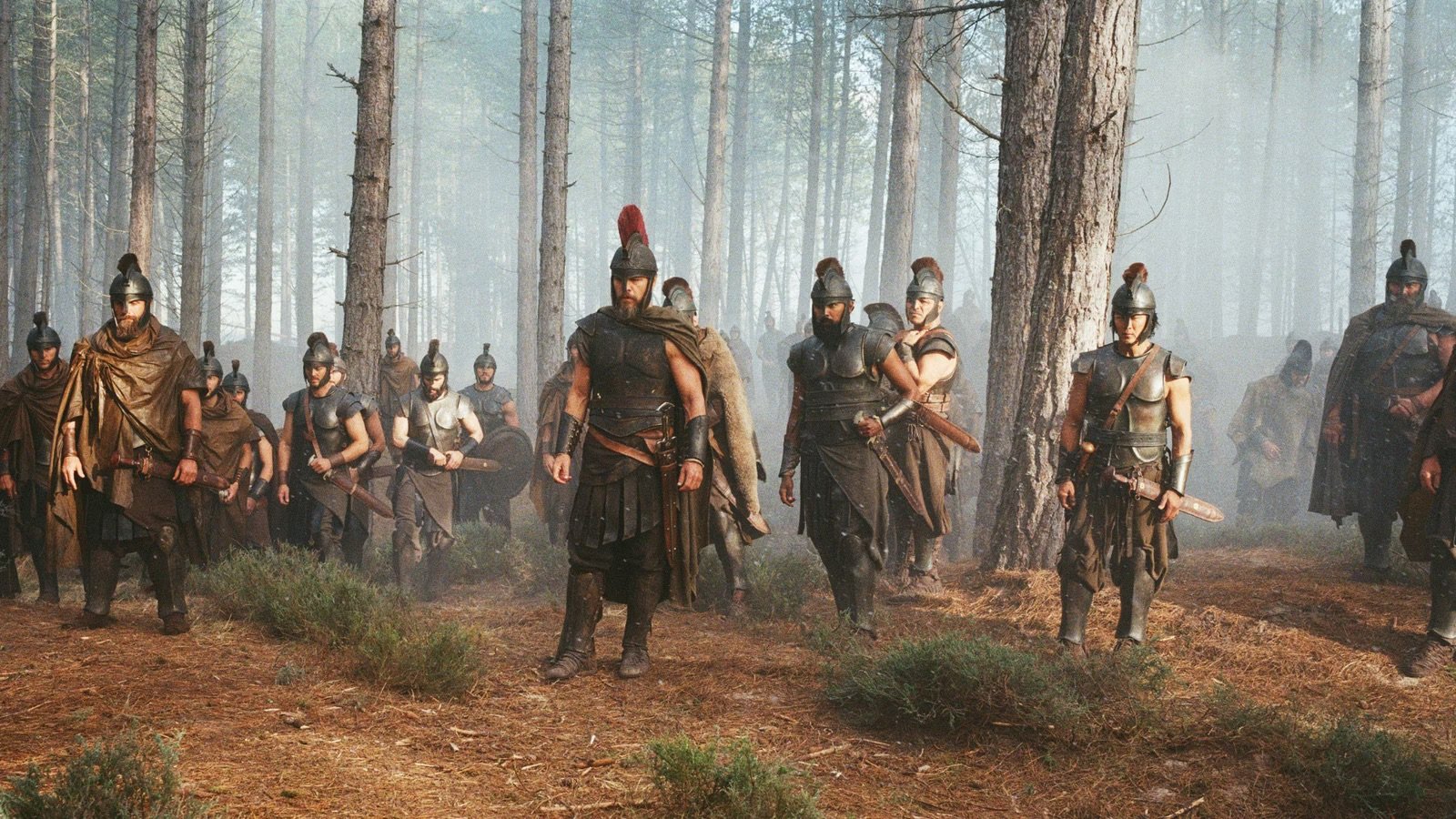
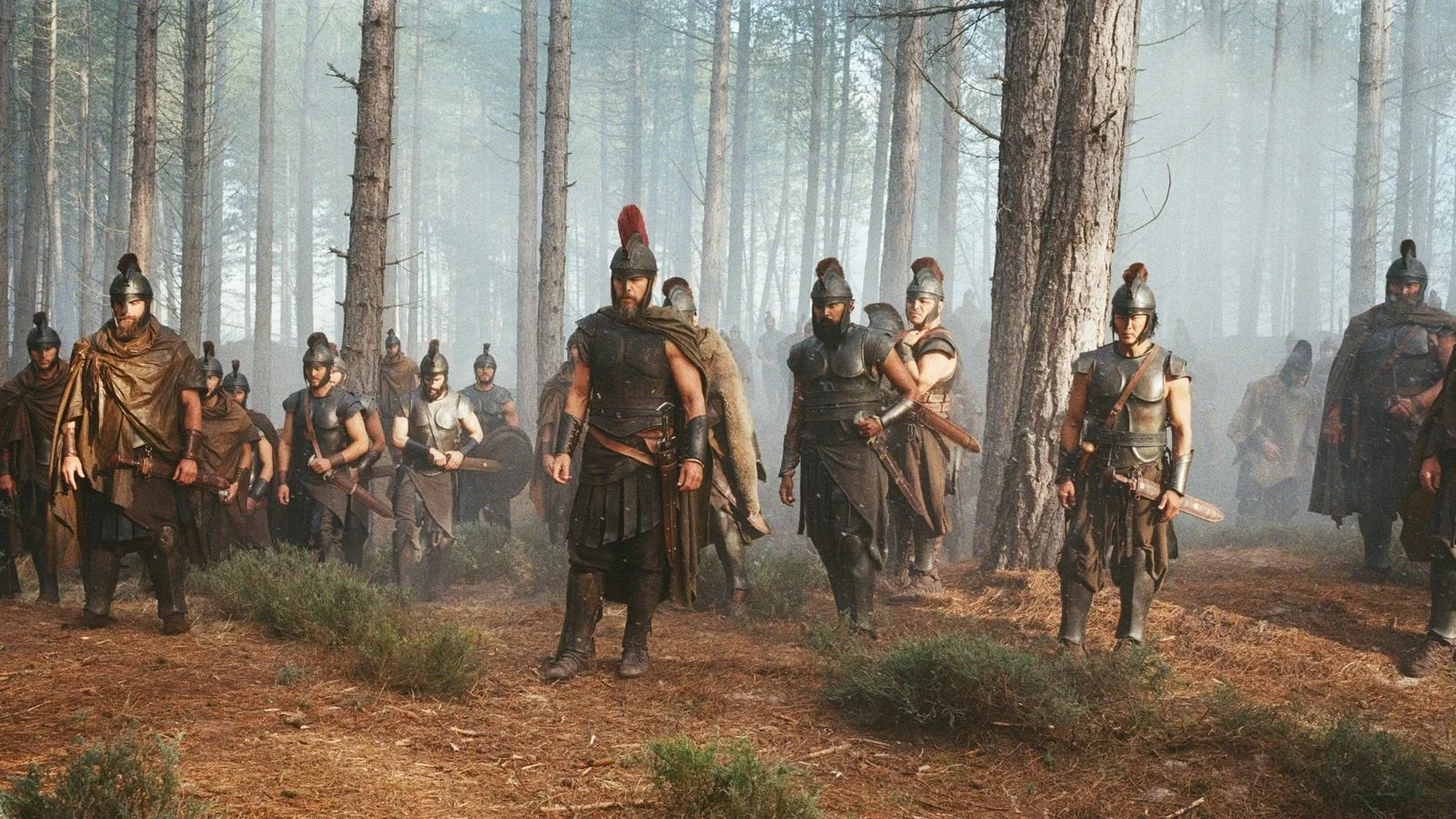
The spectacle is undeniable, as The Odyssey consists of monumental imagery from its opening frame. The landscapes and seascapes are just staggering. Like the significance of this tale, you can’t hope to take it all in within the moment. (Iceland and the Scottish isles provide some support to Italy and Greece in the recreation of Odysseus’ long journey.) Many scenes occur in caves or dim interiors, making the sudden exposure to the Mediterranean sunlight breathtaking. If Nolan’s new picture is always an event, Hoyte van Hoytema’s cinematography—which includes Nope, Spectre, and Her, in addition to other collaborations with Nolan—is always a rewarding enticement of its own.
Ludwig Goransson’s score matches van Hoytema’s craft beat-for-beat. Or, apropos of Odysseus’ bowstring that is incorporated into the score’s movements, perhaps I should say pluck-for-pluck. This element is indicative of the score throughout: integrated with classical movie scoring, but swerving in creative and thrilling directions. Every time the string is plucked, there’s a sensed shockwave of propulsive energy injected into the scene.
The sheer force of the film’s waves begin to calm a bit with the cast and the script. Matt Damon is believable as Odysseus, but he’s not much more than that. The same goes for Hathaway. The next circle of supporting performers make much more out of their roles: Tom Holland is well cast. John Leguizamo captivates as Eumaeus, Odysseus’ servant and friend who becomes a sort of protector watching over Holland’s Telemachus. Meanwhile, Robert Pattinson is having an absolute blast as Antinous—I had as much fun watching him sneer and slink his way toward Ithaca’s throne as I did witnessing Cyclops or Scylla. Performance-wise, the single best scene likely goes to either Himesh Patel as Eurylochus watching Odysseus listen to the sirens’ song, a wordless moment that owes as much to Patel’s expressiveness as Damon’s; or to Samantha Morton, whose speech as Circe transmutes Odysseus just as significantly as her magic transforms his crew.
Patel, Pattinson, and Leguizamo are the MVPs, enthralling every moment they’re on screen. Zendaya, Elliot Page, Charlize Theron are all potent in their scenes, as well. The script unfortunately leaves much of the rest of the cast with too little to work with. Any adaptation of the Odyssey must first make the choice between Homer’s poetry (either by direct quotation or in spirit) or modern vernacular. Nolan opts for the latter, which is an acceptable route, but the actual dialogue often ends up flat. There are ways to give fire to the script without the fuel of Homeric meter. For comparison, Oppenheimer was full of small parts that gave each actor memorable moments. But performers come and go in The Odyssey without making much of an impression. That’s a shame when you have actors such as Lupita Nyong’o, Benny Safdie, and Jon Bernthal in significant roles, no matter how scant their screentime.
The straightforward script serves to emphasize the scale of the action, and The Odyssey delivers. Each episode is a finely tuned miniature arc of curiosity, awe, and fear as the climax approaches. Morton’s sequence as Circe is likely the most unforgettable, given its unexpected swerve into body horror (unexpected in terms of Nolan’s work, not in terms of the epic). The portrayal of Cyclops is its own surprise—a refiguring of Goya’s Saturn that somehow feels restrained even as it chomps down on a soldier. Flashbacks to the fall of Troy offer more classical ancient war thrills, but such scenes have been more immersively imagined in other films.
While the sense of spectacle is persistent throughout The Odyssey, it left me feeling the lack of surprise. It’s nigh impossible to go into the film without a pretty deep familiarity with Homer’s epic, if only through cultural osmosis. But Nolan’s inventive genius has restructured biopics and war films in fascinating shapes, and I wish he’d brought this energy to The Odyssey. One could never call it dull, but it does feel a bit routine for Nolan.
While he doesn’t go too far in complicating the narrative, Nolan does emphasize certain themes to make The Odyssey feel relevant and weighty. His Odysseus achieved victory through deceit, and he must suffer the cost of his victory. His men are deformed by a decade’s habit of violence—while this becomes explicit in the speeches of Circe and Tiresias, it’s visually reflected in the disfiguration of Cyclops, in the odd angles not only of its sole eye but also its nose. Rapacious greed and entitlement turn these men into something other than human. For his part, Odysseus is haunted by Athena, the specter of war appearing to him no matter how far he travels.
As this theme manifests more clearly, The Odyssey forms a rich companion piece to Oppenheimer. The costs of humanity’s achievements, when accomplished through violent means, become too much to bear. Odysseus mourns for the men and years that were lost, and he is openly derisive of Agamemnon’s lust for power. But he also knows no solution other than that of sword and arrow. The farther he goes in his journey, the more he is condemned not only by his victims, but also by his companions. Nolan questions his hero, who in his longing for home violates “all that’s ever been sacred.” Odysseus’ hubris is in no way ancient and forgotten—it is the same hubris at work across modern humanity and its civilizations. Homer’s Odyssey will not be lost to time, nor will it become rote, for it continues to speak urgently into our world today. Nolan’s film is an ode to that lasting power, visualized in stunning imagery.