‘Backrooms’ Boasts Great Design but Unsatisfying Narrative Choices
A24
Somewhere in the adolescent confines of either middle or high school English, I read a short story by Charlotte Perkins Gilman. “The Yellow Wallpaper” tells of a young wife who, after suffering a postpartum emotional condition, is sequestered in an upstairs room arrayed by the fading yellow decor of the title. The decaying state of the wallpaper begins to contaminate the very walls, gradually pushing the woman into madness. The story is an early articulation of feminist thinking in American literature—the wallpaper serving as a symbol of the superficial strictures placed on women in societal life. It’s not really the walls that are driving her toward insanity. It’s the result of everything around her.
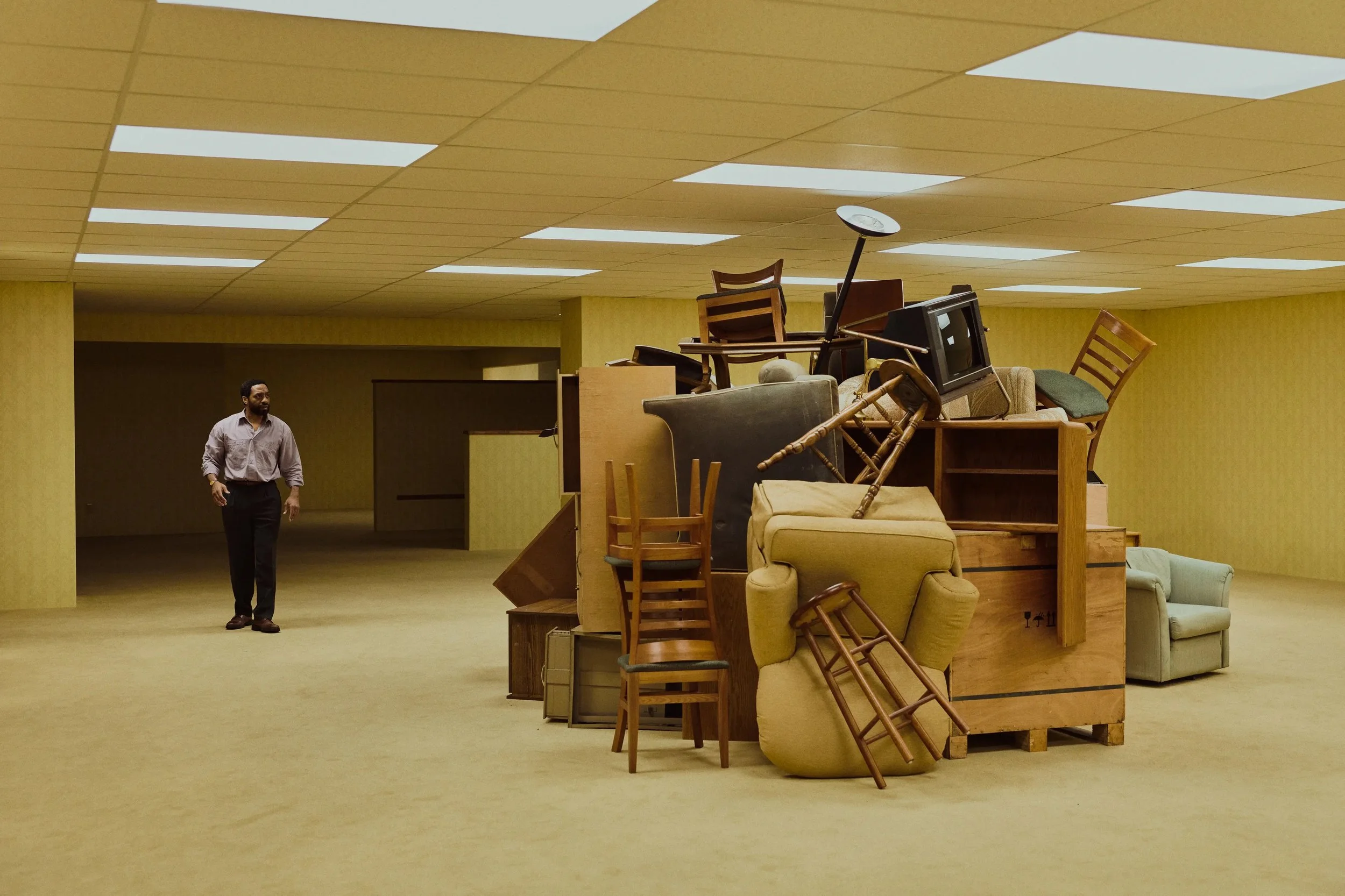
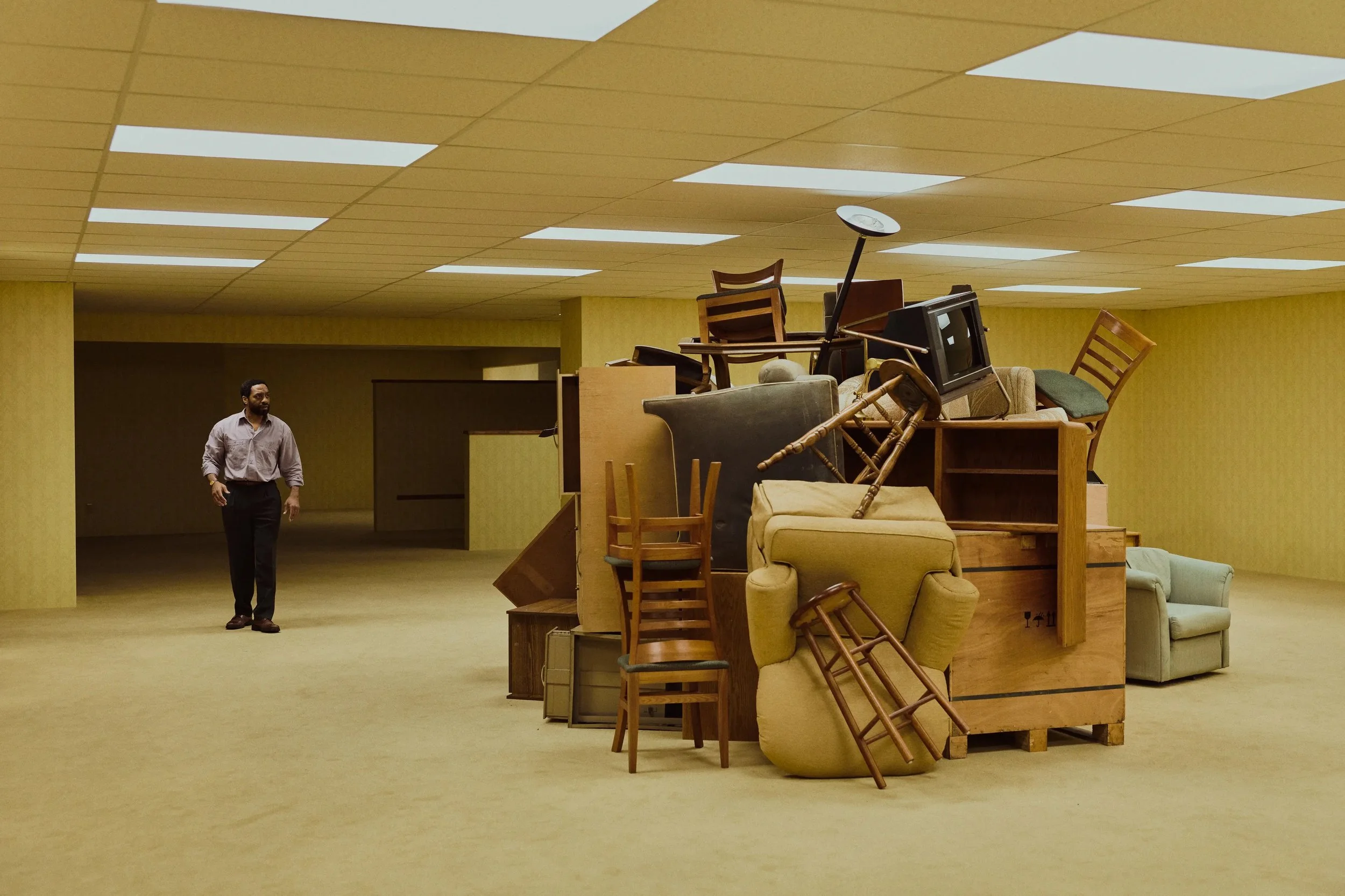
On the release of his feature film debut, Backrooms, Kane Parsons is a few days shy of his twenty-first birthday. While separated in significant ways from Gilman’s life in the late 19th century, Parsons also seems pretty suspicious of yellow wallpaper. The sickly shade covers nearly every inch of the unnatural corridors that Parsons’ crew built for the movie (and they selected a carpet to match). It is the very nature of space that not only houses insanity in Backrooms, but even seems to be the source of that madness. Escape seems unfathomable when the rooms stretch on endlessly.
Chiwetel Ejiofor plays Clark, the owner of a furniture warehouse that seems to be in a state of economic decay. We never once see a customer enter these walls, situated in a nowhere strip mall. His dejection is compounded by his separation from his wife, and his mental downward spiral reads clearly from the start. Perhaps his therapist, Mary (Renate Reinsve), can help him. She appears successful enough, even selling a book and series of tapes that we occasionally hear. The “untrained mind,” her voice intones, gets stuck in “loops, circles, reaching for the same solutions.” As it wanders these familiar neural pathways, the mind is creating a space of “evolving rooms, putting up barriers.” It may be a helpful metaphor for Clark, whose desire is still to turn his architectural training into a better career.
Clark’s mental floorplan becomes even more muddled when he discovers a mysterious door in the basement of his store that leads to a series of rooms and corridors that defy explanation—as well as architectural sense. In the first room, he’s first greeted by a pile of furniture, some of which has melded together in bizarre ways. Another room bears a stop sign (technically, it reads “POTS”). There are doors leading to nowhere, halls that become recursive, pointless pillars obstructing paths. It’s as if M.C. Escher spent his life trapped in an empty office building with no windows. The right word for it is uncanny. It feels wrong. That gnawing sense of unease is only the beginning, though. It seems like there’s a more pernicious, physical danger wandering these halls.
Backrooms, adapted from Parsons’ YouTube series based on an earlier example of creepypasta, crystallizes the concept of liminal horror. If you aren’t familiar with the idea, just imagine the last dream you had where you wandered some space endlessly—maybe you were fleeing an attacker, maybe looking for the right classroom for that exam—a space that made increasingly little sense. Or just walk into a mall these days: It’s impossible to wander through a place filled with stores somehow still open despite so few souls stepping through the doors, the scant footsteps and voices of the occasional shopper echoing through the tiled halls and atrium. These are spaces that seem to have a purpose, or to have once had a purpose. They should have a purpose, but they’re so lifeless and empty. Uncanny.
The film makes a few ventures into this cryptic space, each time revealing a little more of its nature (though it never seeks to give a final answer). The production design is the real star of Backrooms, with architectural designs that just feel wrong, whether its empty pools surrounded by carpet, decor melting into the floors and walls, or pervasively irritating lighting. Parsons sets the action in the early 1990s, which is a savvy choice. In addition to situating the film’s grainy aesthetic, it also means that our sense of unease arises long before we step foot in the backrooms—this is a movie that expertly captures the terror of 90s furniture and local TV ads.
The viewer is immersed in this space by Jeremy Cox’s creative cinematography, which employs handheld video cameras, distorting frames, low angles, and even first-person POV, which aptly creates a cavalcade of Dutch tilts. We are always visually off balance here, never able to find our footing.
Ejiofor is a great performer for communicating the complexity of Clark’s experience. On the one hand, his mind is fraying from economic, relational, and emotional fallout. On the other hand, his imagination, while initially troubled, begins to soar as he explores the backrooms. It’s a remarkable discovery verging on an obsession. This might just be the inspiration that frees him from his downward spiral. Or, it might become the labyrinth he’s forever trapped in.
The more the film insists on tying its world to its characters’ mental state, the less it astonishes. As the excerpts from Mary’s tapes suggest, the link between the two isn’t subtle by any stretch. It’s an obvious idea from the start, and Parsons does nothing to make it more thought provoking as our journey into the backrooms deepens. Reinsve is solid, able to work with what the script provides, but there’s not much there except heavy handed psychologizing. The same goes for Mark Duplass, whose presence is as enjoyable as it is unnecessary to the story.
Backrooms is far more fun in its first hour than its last thirty minutes as its climax underwhelms. And it’s probably a movie more fun to think about after the fact. I realize that’s quite faint praise, but it also means I’m still having some fun with it, so that’s alright.
While the film falls apart psychologically, it exceeds its intent as a cultural critique. In Postmodernism, or, the Cultural Logic of Late Capitalism, Frederic Jameson turned to the examples of superstructure malls and public plazas to articulate postmodern architecture. He argued that these styles intentionally disoriented the people within them, such that the best signposts they had for direction was the gleaming storefronts promising direction via consumerism. They were “every places” as much as they were “nowhere places,” and this gives us a fitting description for the backrooms. They could be anywhere, in any office building or strip mall or government institution; yet they are lifeless, unreadable, unnavigable.
This is the real terror of Backrooms—monsters notwithstanding. The spaces created are a reflection of the modern soul. The rooms are too empty but also too full. They feel like they must have a purpose, but there’s nothing to signify other than that backwards stop sign. These are spaces that, from all visible indication, are created by humans, yet could never be for humans.
The downward psychological spiral that results returns us back where we started. As with Gilman’s story, it isn’t actually the yellow walls or anything about the space itself that is unleashing insanity. The uncanniness contaminates and pervades every space, every medical waiting room, every business center, every upstairs room. The source of insanity is already there in the structures of a society architected by patriarchy or by consumer capitalism. Which is to say, we have always lived in the backrooms.