‘Wheel of Fortune and Fantasy’ Spins Around A Relational Nexus
Neopa
As anyone entranced by Ryusuke Hamaguchi’s Drive My Car—winner of the 2022 International Feature Film Oscar, nominated for Best Director and Best Picture—will tell you, the director is a wizard when it comes to conjuring powerful drama from simple, direct conversations. With his latest film, All of a Sudden, receiving significant critical acclaim at this year’s Cannes, and with the frustration of having to wait who knows how long before it gets a stateside theatrical release, I took the chance to sit down with Hamaguchi’s other 2021 drama that masterfully portrays the complexity of desire within human relationships.
Wheel of Fortune and Fantasy is a triptych film, with each of its stories lasting around half an hour. The sections are rarely more eventful on the page than a few conversations, and they each focus on at most three onscreen characters. On the one hand, the film is constructed out of prosaic material. Yet that material is precisely the material of our experience: the happenstance moments of communication that can open up new possibilities, rupture the relationships we’ve cultivated, or reframe our perspective on life.
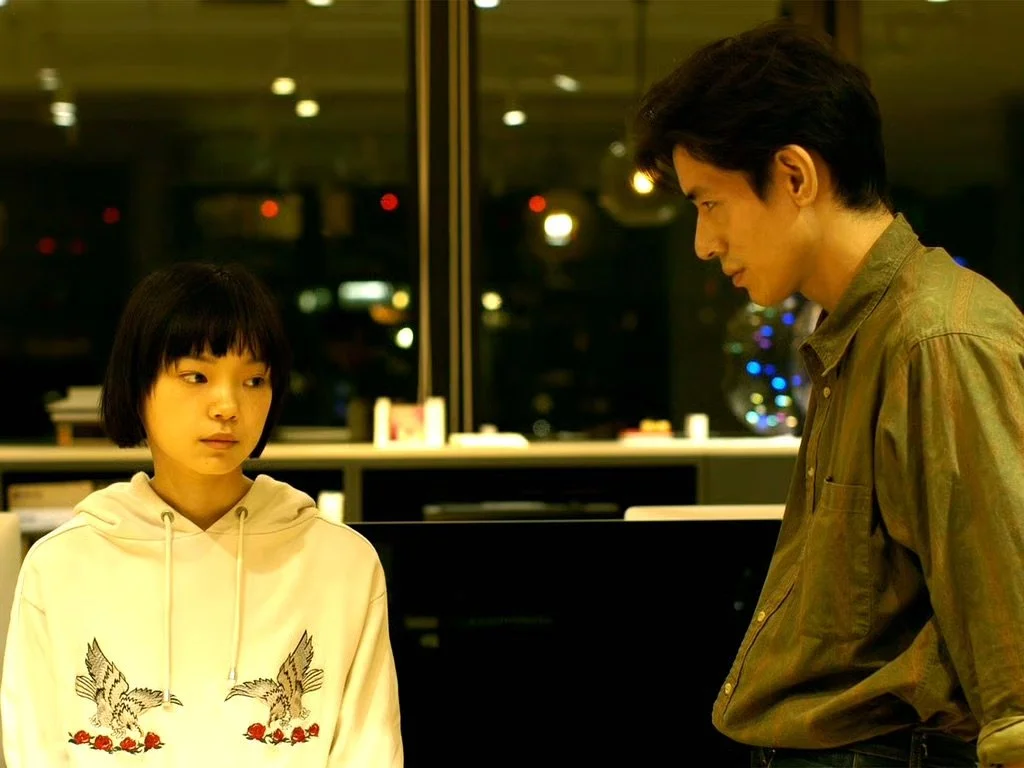
The first episode, “Magic (or Something Less Assuring)” begins with a very familiar Hamaguchi scene—two people in a car talking about relationships. Mundane? Perhaps. But if you’ve seen Drive My Car, this actually triggers an immediate tension and anticipation of divulged significance. Tsugumi (Hyunri) tells Meiko (Kotone Furukawa, also in last year’s Cloud) about the electric first date she recently had. Despite being initially hesitant, she and the man talked for hours with a profound sense of connection. Did they have sex? Meiko asks, but no, they just talked. Still, Tsugumi says, “I didn’t know conversations could be this erotic.” (She obviously has not seen Drive My Car.) The scene establishes two of Hamaguchi’s unique gifts: First, it manifests the power of a recounted encounter. Listening to someone reminisce about a relational encounter may not sound cinematically thrilling, but in the hands of Hamaguchi (as with Bergman in Persona) it becomes transfixing. Secondly, it affirms Hamaguchi’s abundant generosity toward his performers. The camera is still, mostly fixed in a two-shot on Hyunri and Furukawa as they talk. The women are not only trusted with the material, but they are trusted to breathe life and emotion into it. These are core elements of Hamaguchi’s filmmaking, both of which give an apparent simplicity to his work that covers over a remarkable, human depth.
All is not well, however, as becomes evident after their car ride. Tsugumi’s exuberance puts Meiko in a bind, through which she reveals a completely different side of herself. Furukawa gives an outstanding performance, complicating the characterization within a short section.
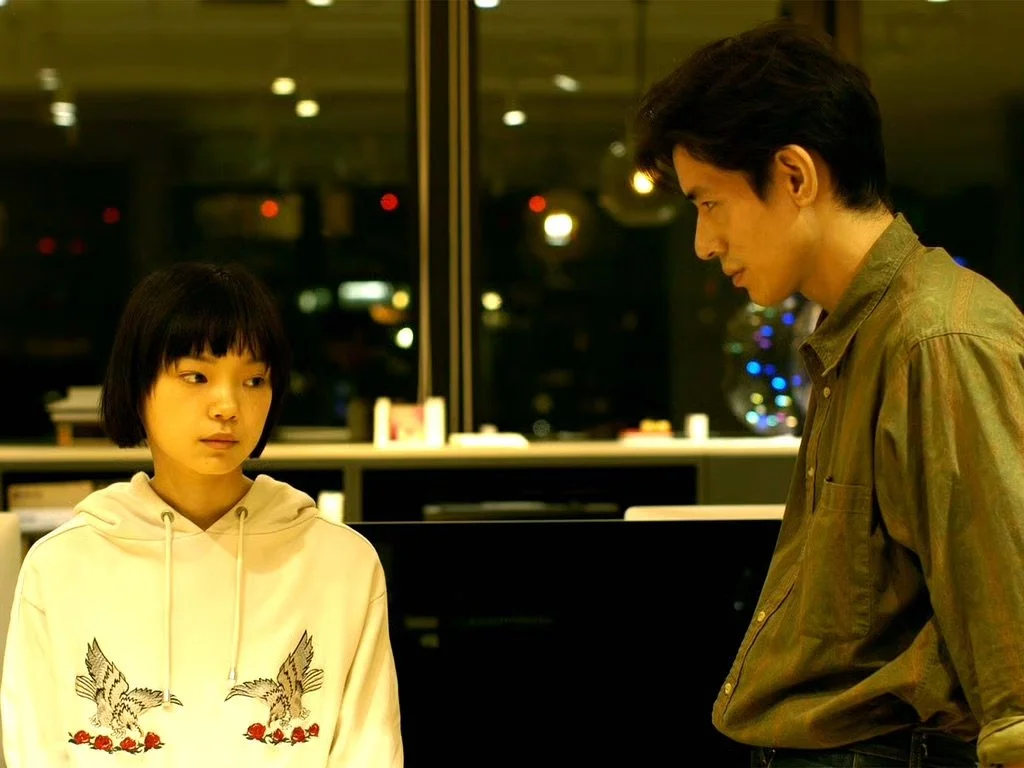
The tension that gradually bubbles up in “Magic” is part of the initial setup in “Door Wide Open.” A young mother, Nao (Katsuki Mori), is balancing university studies, parenting, and at least one affair with a younger peer. She’s a bit of an outsider among the other students, so the promise of inclusion is enough to convince her to attempt to seduce and betray Segawa (Kiyohiko Shibukawa), an award winning author and professor. Nao arrives at his office hours and talks about his book, asking if she can read an excerpt that moved her. Said excerpt happens to be a lengthy sexual encounter, which she hopes will incline Segawa to make advances. It’s tense even though the film itself is just two people talking in an office (with a perpetually open door). Open doors can also form a boundary of sorts, however, just as they form a threshold, a line to be crossed. Which boundaries will hold and which will be transgressed is the uncertainty. Hamaguchi playfully winks in this section by having the professor discuss the decision to include the lascivious scene, saying that by “putting this in the middle, I figured readers would want to read to the end.”
Reading to the end takes us to Natsuko (Fusako Urabe) and Aya (Aoba Kawai), two women who run into each other after a school reunion. In a brief comedy of error (and a prefiguration of what’s to come), the two recognize each other while moving along opposite escalators—then both cross again in an attempt to catch up with each other. After they finally reconnect, they return to Aya’s house. As they discuss their old school days and where life has now brought them, it becomes evident that Natsuko has something more biting on her mind. But when she finally gets ready to broach the topic, the conversation takes an unforeseen diversion.
The title of Hamaguchi’s film can be refracted in different ways. “Wheel of fortune” could be taken to outline the first scene, and “fantasy” fittingly describes the film’s finale (with the question of what lies between these two poles inhabiting the middle scenario). But these individual elements can also be seen throughout each episode. The “what are the odds?” instigation in “Magic” prompts Meiko to fantasize about new futures. Likewise, “Door Wide Open” tempts with the imagination of something bawdier and ultimately hinges on a proofreader’s typo. And while relational playacting (we’re back to Drive My Car) pervades the final chapter, the arbitrariness of Aya and Natsuko’s reunion comments on the larger randomness of fortune. To this complexity, there are two very emphatic zooms in the film which seem to call attention to the possibility of diverging paths.
Wheel of Fortune and Fantasy is a small gem of a film carved out by Hamaguchi’s distinct gifts. Its episodic structure makes it slightly more schematic and less potent than Drive My Car or Asako I & II, but it nevertheless demonstrates the ethos of one of the sharpest directors working today.