Corrosive Consumerism, Clutter, and Alex Cox’s ‘Repo Man’
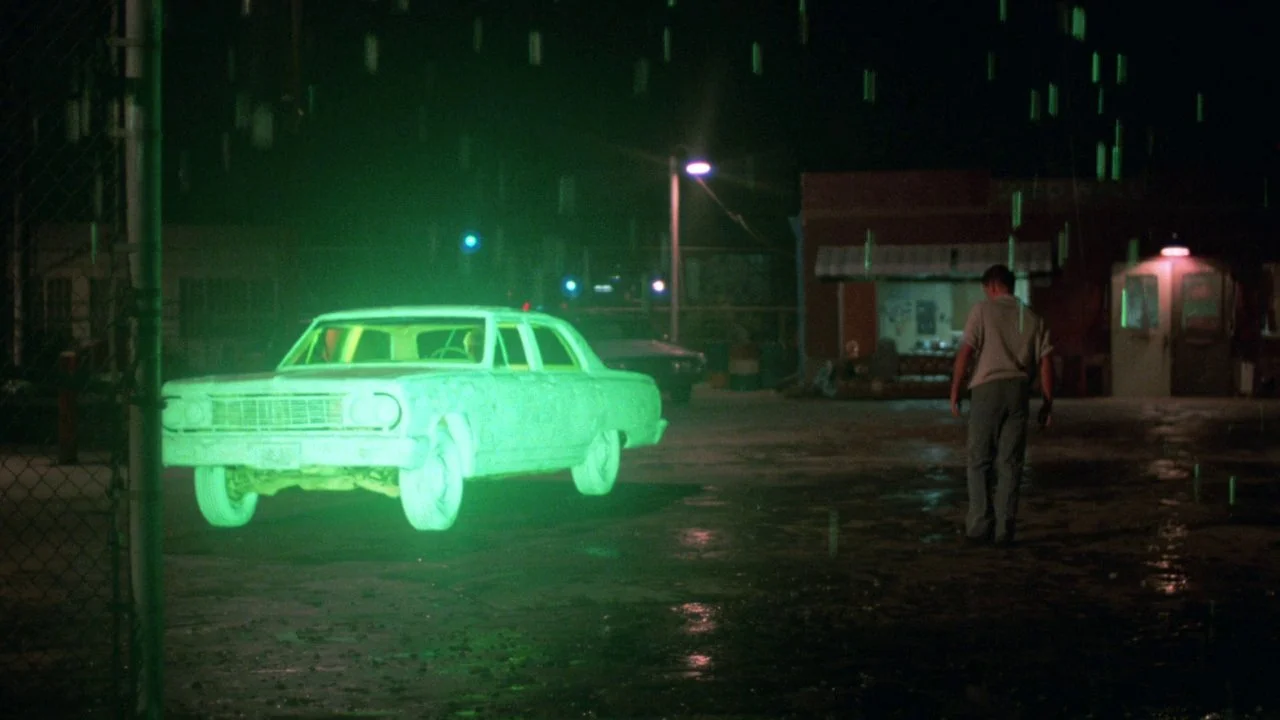
Edge City Productions
1984 saw the release of The Terminator and Ghostbusters, two sci-fi films that would become cultural icons and launch franchises that persisted, if sputteringly, with releases in the past decade. But that same year also gave birth to a sci-fi film that never enjoyed a fraction of the zeitgeist, though it’s gained cult status over the years. It’s a film that’s equally prescient as The Terminator and infused with just as much off-the-wall energy as Ghostbusters. Hop in this busted sedan and go for a ride with Alex Cox’s Repo Man. Just—don’t look in the trunk.
There’s no denying that Repo Man is a cultural oddity. In fact, just drop the qualifier: it’s an outright oddity. This is a film where cops discuss a mysterious incident that claimed the life of a highway patrolman: “It happens sometimes, people just explode.” Such heights of stoic acceptance are matched by extreme honesty by the televangelist seen reassuring his loyal disciples. He’s been accused by others as a con man, but never worry, because he says, “They’re right—I do want your money!” It’s ridiculous, but there’s a point to all of this, or at least a scathing reflection of society.
As for the plot of the film, Otto Maddox (Emilio Estevez) is an aimless young man in need of cash but frustrated by the dead-end jobs he’s attempted. An inadvertent run-in with Harry Dean Stanton’s Bud leads him into the world of repossessors who snatch cars of anyone who’s defaulted on their payments. They cruise the town in junky cars looking to sneak away other junky cars without a confrontation. It doesn’t always go down that way, of course. These men and women form their own fringe society, angry at the mainstream world of capitalistic success, but dependent on pinching property from others struggling to get by. As such, they aren’t welcomed by anyone, forced to make what home they can in among the highway overpasses and chainlink lots. There’s one car that’s getting some extra attention these days. A car that seems to disappear and reappear arbitrarily across the American Southwest. A car that’s being pursued with the ineffective tenacity that can only originate from mysterious government agencies. A car that might just have an alien in the trunk.
The plot, however, is less important that the film’s gonzo energy and its aesthetic. Regardless of how nonsensical the narrative becomes, these elements loudly express Repo Man’s grimy angst against a media-addled culture. As the film scholar Vivian Sobchack writes in her book on 1980s American sci-fi movies, Screening Space, Repo Man “embrace[s] trashed-out, crowded, and complex urban space, and appreciate[s] the closure of the future for all the surprising juxtapositions such closure allows and contains.” The closure of the future is what Otto and those his age are experiencing—the American Dream that once promised an open highway is little more than a rote suburban cul-de-sac. What self-respecting eighteen-year-old would want that (if they could actually achieve it)? The endless waste produced by American culture—whether it ends up in dumpsters or broadcast television or on grocery store shelves—communicates a message that clutters Cox’s images.
Sobchack comments that “the ‘clutter’ experienced by a thoroughly commodified culture” becomes a part of “the very mise-en-scène and aesthetic value” of the film. And what an aesthetic it is—perhaps the grandest achievement of the film (abundant credit is due to Production Designer Lynda Burbank). Products are everywhere, but Repo Man makes no space for brand recognition. Instead it comments on the replaceability of every product and the pointless facade of consumer choice by arraying everything in the same white and light blue labels that simply read “corn flakes” or “beer.” Otto gets home late one night, opens the fridge, and begins eating out of a can that advertises itself as “Food.”
The cast is game for these shenanigans. This is Estevez a year after The Outsiders, a year before The Breakfast Club, throwing himself into Otto’s angst. As the strange events only get stranger, he captures the tinge of shock that’s quickly replaced by adolescent unresponsiveness. His can’t-be-bothered attitude is complemented by Harry Dean Stanton’s too-tired-to-care-anymore Bud. Is there any scenario that Stanton can’t ground? (For context, Repo Man released the same year as Wim Wender’s Paris, Texas.) Bud quickly warns Otto, “No Commies in my car!” and follows it up with “No Christians, either.”
Repo Man inverts the frequent sci-fi scenario, depicting the pre-apocalyptic mania of American culture. Watching it makes you “feel as if your mind is starting to erode.” Or possibly as if you’re finally waking up to the erosion that’s been happening for decades. To be honest, it feels like we’re due for another such bizarro, chaotic sci-fi destined for eventual cult status. Which is to say, it doesn’t feel like we’ve exactly addressed the issues Cox skewers, and we may have just circled back to the same dead-end road. One character puts it bluntly, succinctly: “I blame society.”