Laika
Last Saturday was the apotheosis of Pacific Northwest beauty in autumn, and I was lucky to spend much of the daylight hiking along the Columbia River gorge, just on the northern side of the river. About a third of the trees had shed most of their leaves, and the ones that remained were adorned in all manner of umber, green, brick red, and bright yellow. The air to start the day was chilly, a slight, crisp breeze making it moreso, but the sunlight pierced the forest in places and eventually warmed the air. Whether looking down from high above or descending toward the teal water at the river’s edges, I couldn’t have asked for a better day to hike.
I also couldn’t have asked for a better amuse-bouche before watching Wildwood, because we later went into Portland for sushi and then made our way to a theater and watched Travis Knight’s latest film. Having been already immersed in the beauty of the Columbia, I was invited to revel in it once again—this time in stop-motion finery.
Wildwood, the newest animated feature from Laika Studios (Kubo and the Two Strings, Coraline), adapts Colin Meloy’s YA fantasy novel of ancient magic and mystery in the PNW. Prue (Elizabeth Peyton Lee) lives in Portland with her parents and younger brother, Mac. Even if you don’t recognize any of the Portland locales—Powell’s and Voodoo Doughnuts make cameos along with food truck squares and many emerald bridges—you can probably identify the setting by the most Portland family possible. Even the design of Prue’s dad (familiar voice actor Jake Johnson) screams Portland urbanite.
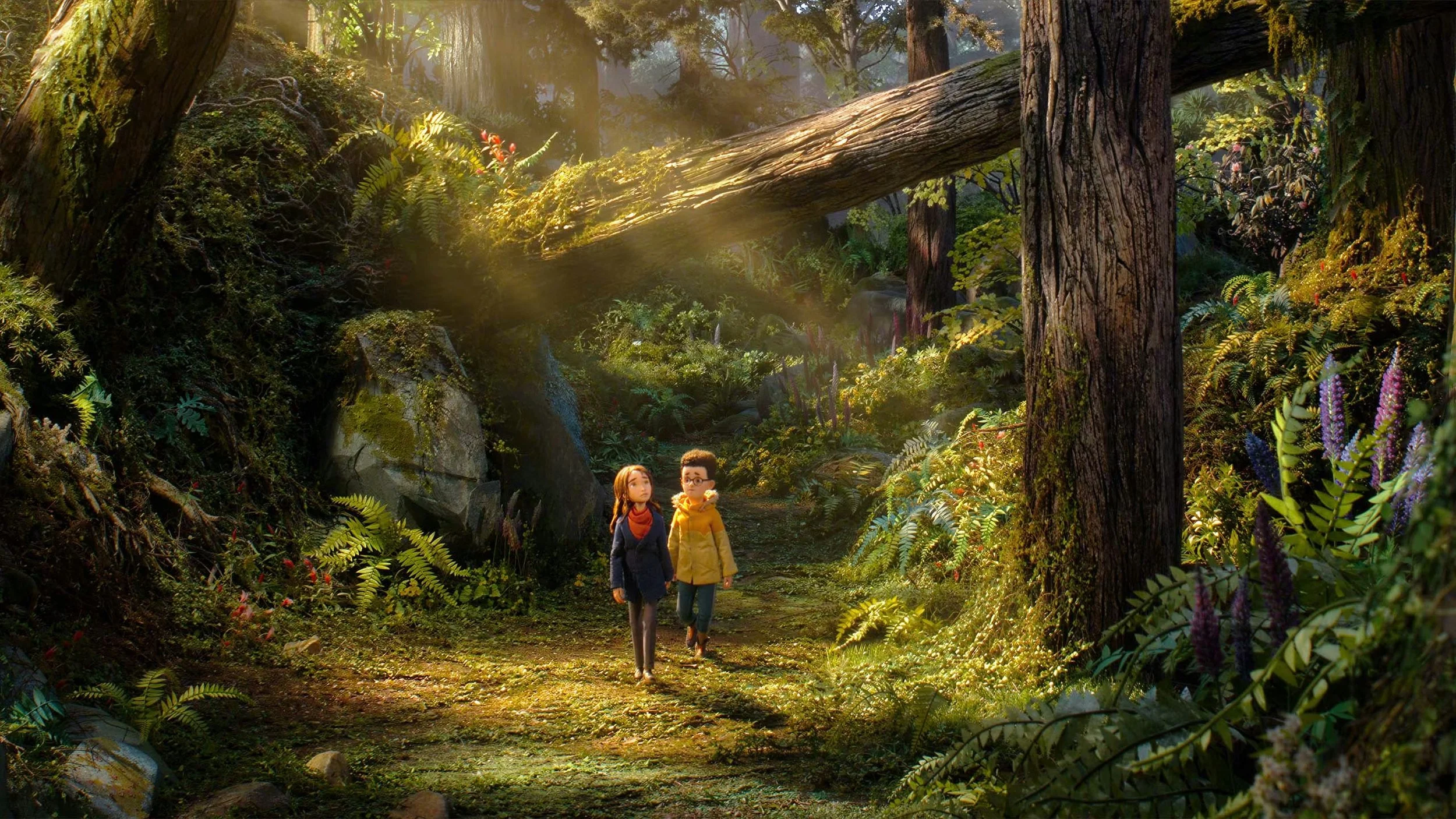
This world also extends to the north and east along that same Columbia River gorge that I had been hiking, and Laika’s attention to detail dials up toward overdrive in arraying the entire region in stunning beauty. The craft and attention that were required to create the forest, cliffs, and city are impressive enough, but I was enamored with the sense of light that the film’s crew achieves. It all captures the angled fall light through the streets of Portland, or the dazzle of rays in open sunlight, and the result is a magical sense of place achieved through an uncommon material format.
What a beautiful world it is—but it is also a terrible world. Burdened with babysitting duties while her parents attend a craft fair, Prue ignores their warnings to stay inside and takes Mac instead on a ride through the city. A quick break at a playground becomes a direct homage to Hitchcock’s The Birds as an unsettling number of crows gather on a jungle gym before swooping through in a cloud and kidnapping Mac. Prue, now with the unwitting Curtis (Jacob Tremblay) accompanying her, races through town and across the river into the dense forests full of trillium and ivy in an attempt to follow the murder. They don’t find the crows, but they do find a pack—or better yet, a detail—of talking coyotes out on patrol.
This encounter acts as the rabbit hole that ushers Prue and Curtis into an entire world unlike any they know, despite how close it is to home. Talking animals abound, but this whimsical landscape is battle scarred and strained. The crows and coyotes report to the Dowager Governess (Carey Mulligan) and are slowly tightening their grip on power; the rest of the birds form the Aviary Principality; a human tribe of bandits (led by Mahershala Ali’s Brenden) roam as highwaymen; and the rest of the humans and animals order themselves in a rather bureaucratic system situated in Pittock Mansion. The divided factions already make for a tenuous environment that Prue’s quest will tear wide open, setting the stage for an epic showdown between the forces of good and evil.
Meloy’s songwriting with The Decemberists has often found delight in the mishmash of references and influences, and the story of Wildwood is the result of a similar inclination. Early whiffs of Peter Pan and Alice in Wonderland make room for Frankenstein asides before staging setpieces indebted to The Lord of the Rings or The Chronicles of Narnia. It’s familiar, but not reductive. Rather, Wildwood takes these predecessors and turns the Northwest into a fantastical sandbox that, combined with Meloy’s characteristic elocution, makes for a thrilling time.
Despite some of those influences, this is not quite a young kid’s tale. A consistent sense of violence and consequence pervades this land, and it all leads to a plinth that towers toward the trees where an attempt at child sacrifice will occur. The magic of Wildwood is always something more ancient and unknown than welcoming: the ivy embodies some ur-force, a presence not to be trifled with. This is an altogether older sense of our relationship to the forest and the rivers, as places of power that are beyond our control, that defy our borders and limitations.
The arc of the plot is easy to trace, but the pleasure is in the wonder of this world. The voice ensemble is roundly excellent (I have not even had a chance yet to mention Charlie Day, Angela Bassett, Tom Waits, or Awkwafina), memorably characterizing turncoat coyotes, regal owls, rats, and more. As with many of Laika’s creations, however, the visual craft and worldbuilding are the unforgettable achievements. I’ve already gushed about the urban and natural environments that Knight’s team creates, but the character models and movement are also expressive in each scene, with how they move as much as their facial expressions. And there are some great oners in the battle scene that combine stop-motion expertise with cinematic techniques in inventive ways. The detail (and therefore the commitment of time and energy) is often the focus in admiring stop-motion films. It’s certainly true with Wildwood. But the creativity, expressivity, and excitement the team achieves with that detail is what puts Laika at the forefront of American animation, pushing the boundaries of what this medium can achieve.