The Ecstatic Tension of ‘Sirât’

Movistar+
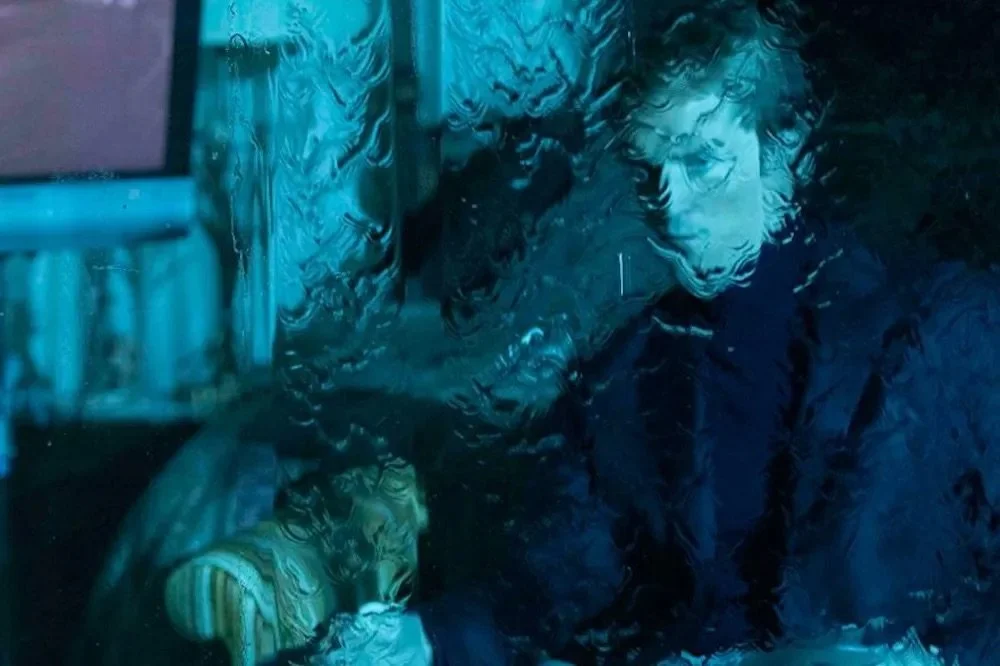
Toward the conclusion of William Friedkin’s 1977 Sorcerer, as the jungle that the characters have been slowly driving through finally shrinks in the rearview with all its berserk tension and sudden eruptions of violence, the landscape shifts to a new form of terror. Architectured by unearthly columns of rock and drowned in murky blue, it becomes a landscape of psychological fracture. Whether there is any remaining physical danger is beside the point: the previous nerve-searing sequences have so throttled character and audience alike that the accumulated tension cascades into an immense pit of dread. The world is no longer recognizable. Nightmare has taken over.
If you attempted to extend the emotion of that sequence across half a film’s runtime, you might just end up with something like Óliver Laxe’s Sirât, a movie clearly indebted to Sorcerer (and its cinematic sibling, The Wages of Fear). If Sirât understands one thing, it’s that the rush of life-or-death tension isn’t so far removed from the thrumming sensation of losing yourself in music. And with the film consistently accelerated by Kangding Ray’s techno score—which itself seems a nod to Sorcerer’s Tangerine Dream soundtrack—it’s easy to get lost in the movement. Be warned, however, because Laxe’s movie makes clear that you might just lose yourself entirely.
Sirât opens with the construction of a rave in the Moroccan desert. Beneath a canyon wall a new wall is being built by hand: a bulwark of speakers to fill the vast landscape with a spirit of sound. The first few minutes simply respire with the energy of those present, observing the manner in which the music possesses them, body and soul. This prelude constructs an ecstatic vision of a society that can’t last. The characters become icons of simultaneous communion and separation amid the dance; they seem united in purpose, but they are each in their own isolated experience. As the ravers arrive, so too does Luis (Sergi Lopez) and his son, Esteban (Bruno Núnez). Luis is searching for his daughter who’s been missing for months, and they’ve come to the rave hoping to find her or at least someone who knows her. They have little luck, but they are told of a subsequent rave happening later in the desert, and maybe they’ll find her there.
It turns out that this party isn’t the only society that can’t last: the unexpected arrival of a new world war dismantles the assembled group. But as E.U. soldiers evacuate the crowd to bring them to safety, a small group of attendees escapes the convoy to make their way to the next rave. Desperate to find his daughter, Luis follows them, bringing Esteban along with them. Though they’re initially irritated by the unwanted tagalongs, Luis and his son are gradually welcomed into yet another family of sorts. Once more, however, this community is tentative and fragile, and the journey to their destination will threaten to tear them apart for good.
As with Friedkin’s and Clouzot’s films before it, Sirât is punctuated by moments of asphyxiating tension and breathtaking beauty. The Moroccan geography is stunning, and Mauro Herce’s camerawork renders its immensity with the quality of a fabled realm, but it isn’t accommodating to this ill-prepared hodgepodge partiers. Rivers, rocks, steep cliffsides, and the scarcity of resources will plague this journey—and your nerves. Just try sitting calmly when the camera peers out the window of a van to gaze hundreds of feet below the ledge that is mere inches away, all while Kangding Ray’s coarse rhythm relentlessly persists.
When things go wrong, they go wrong without warning (though in a sense of foreboding as vast as the desert). The turns of violence are so sudden that any breath you have left is knocked out. They are unanticipated and pronounced, yet portrayed as unremarkable; they simply happen, and that might just be the worst part. The characters can’t predict them, prevent them, or process them. In a similar way, these instances are also the decisive moments for the audience. You may recoil at the sheer aleatory nature of Sirât’s tragedies, in which case you’d gladly be stranded in the desert to avoid spending anymore time on this roadtrip. You may reject the whole film on the basis that, much like the Moroccan desert, it’s stark, staggering—but ultimately empty.
And you’d be right, on one hand. If narrative substance or thematic coherence are to be the criteria, Sirât is liable to become a wholly frustrating endeavor. The opening title card refers to the bridge of Sirât from Islamic writings, which “connects Paradise and Hell” and is “thinner than a strand of hair and sharper than a sword.” The film doubles down on a potential spiritual framing through the visual of a vibrant Jacob’s ladder in the canyon as the early rave hits nightfall. If this is the framework, then it opens up the later violence to be read as judgment (and the dry landscape as a potential purgatory). But these characters remain unknown to us, and any attempt to map their choices as moral failures or achievements falls short.
But perhaps these are the wrong criteria for Sirât. In his book, Noise / Music, Paul Hegarty writes: “Noise disrupts rational mental control… Noise does block thought, blocks attempts to structure meaning and coherence.” And Sirât is undeniably about (and structured by) noise. If Hegarty’s correct then reading meaning into the film is a quixotic goal. But that doesn’t leave us adrift. What is central to Sirât from the very first beat is the experience of noise. In Laxe’s film music is a presence—its whumping base rushes through bone and muscle. And it is spirit, inspiring and possessing those who are eager to succumb to its power. Apart from the wonders of the Moroccan desert, the images that most transfix are those where the actors readily lose themselves in the flow of the sound. The early rave is paired with a later scene, the smaller group reaching for some emotional catharsis and bodily transcendence. The performers become riveting in these scenes.
And this, I think, is the core of Sirât, not as a theme but as an experience: ecstatic transcendence. Hegarty notes that “the experience of noise has been thought of as ecstatic… and this is far from wrong.” The world is fractured and noisy, but it is through the propulsive noise of the rave that these characters can escape that world. They are reaching for the ecstatic moment. Just as with the tentative picture of community in the opening, however, ecstasy is a difficult thing. It’s not wrong to turn to music for this, Hegarty says, but “the mistake would be to imagine any lasting freedom emerging from that ecstasy.” It offers escape from the world, even one’s own body, but that separation can also cut like a sword.
Losing one’s self in noise “is certainly more ecstatic than pleasant, and closer to the sublime than the beautiful,” Hegarty writes. I can hardly think of a better description for the experience of Sirât. Or I can perhaps think of one. In the film, one of the ravers asks, “Is this what the end of the world feels like?” The answer very well might be yes.