‘Rose’ Writes a Story of Deception, Selfhood, and the Miracle of Being New
Rose. Schubert
Markus Schleinzer’s Rose is a film that exists in a dialectic of its own design. A period piece set sometime in the seventeenth century, it is inarguably fluent in contemporary debates of selfhood. Yet even as it enters into modern conversations, it never relies on any terminology or stylization except its own. As fixated as it is on the brittle nature of survival that rural life following the Middle Ages required, Rose is a movie awash in lush, striking imagery that makes one forget, for a moment, the necessity of rough, manual labor. It is earthy, physical, and human; but its horizon is also open to the Holy Spirit and the lesser spirits of man’s religious structures. The film is indebted to the art of Andrei Tarkovsky, Carl Theodor Dreyer, and Ingmar Bergman—quite the arthouse influences, but its momentum never tarries. These apparent juxtapositions, however, are the very nature of Schleinzer’s film, and they would come as no surprise to the two voices which drive Rose forward.
The first voice, our guide into the film, is that of a narrator who frames it as the story of Rose (Sandra Hüller). Growing up as an orphan meant that Rose suffered both the restrictions and odd independence that came with such status, and somewhere in that upbringing she recognized that the world offered more to a man than to a woman. Donning armor and posing as a man, she fought in the Thirty Years War prior to the film’s opening. We only get a sense of what this experience encompassed—the opening frames show smoking fields filled with mass graves of soldiers, bones strewn across desolate hills. In time one deception led to another: Rose takes the possessions and identity of a fallen comrade, returning to his village to claim his inheritance.
This is where we begin to follow Rose’s story. The villagers greet her with confusion followed by gradual acceptance as she proves herself capable of restoring a farmhouse and establishing a flourishing existence. To them she is simply the “soldier,” at times the “misfit,” but while they seem a bit apprehensive of this figure, they never doubt this man’s word nor his capability. There’s an inevitable parallel to Joan of Arc, a thread that passes through both European history and cinematic history. This story is more immanent, more existentialist—Rose is not led by the explicit voice of God, but by her own conviction.
The voice-over remains clear and overt throughout the film, but it is far more complex than it seems. It never functions as Rose’s interiority; it does not invite us into the emotional state of this taciturn character. At times it widens the thematic arc of Rose, speaking of God and the land in ways that extend beyond the practical, immediate focus of the villagers. It dips into irony at will, even becoming humorous on occasion (“Rose’s feelings of fatherhood were more complex”). The narration ventures where Rose’s voice will not, but also where the world will not. It slips beyond history, beyond the diegetic present. Yet it evades turning this tale into an abstract fable.
The second driving voice is that of Rose, herself, though it may be more accurate to revise: there are not two driving voices, but one driving voice and one driving body. For Rose is sparse on speech, though she is far from mute. The character is pervasively defined by Hüller’s physical presence, a choice that resonates with the story’s themes. This person was a soldier, at once familiar with the strain of battle and the bodily stress of keeping her identity a secret from the men around her. The cessation of war only gives way to “the battle with the land,” and Rose must confront a new source of constraint and hardship. So words for her are simply functional, used to accomplish the tasks set before her. She takes to her new life well, but “once necessity is satisfied,” the inevitable question is how to gain more. It proves a dangerous question.
As a character, Rose is a remarkable credit to both the script (by Schleinzer and Alexander Brom) and Hüller’s performance. It would be far too easy for this character to fall into a number of traps or tropes. A conniver, a defiant pugilist, a timid loner, or a mystic figure. Instead Rose is a survivor who tethers herself to simple goals and small gains. She’s savvy enough to deceive those around her, but she also makes mistakes, and the randomness of life threatens to unmask her secret despite her attempts at control. Hüller leans in to the physical demands of the performance, often posturing in silence or thought. But she’s also prepared to fully express Rose’s stronger emotional instances of anger or desperation, and Hüller gives full force to these even under facial prosthetics (displaying the disfigurement of battle).
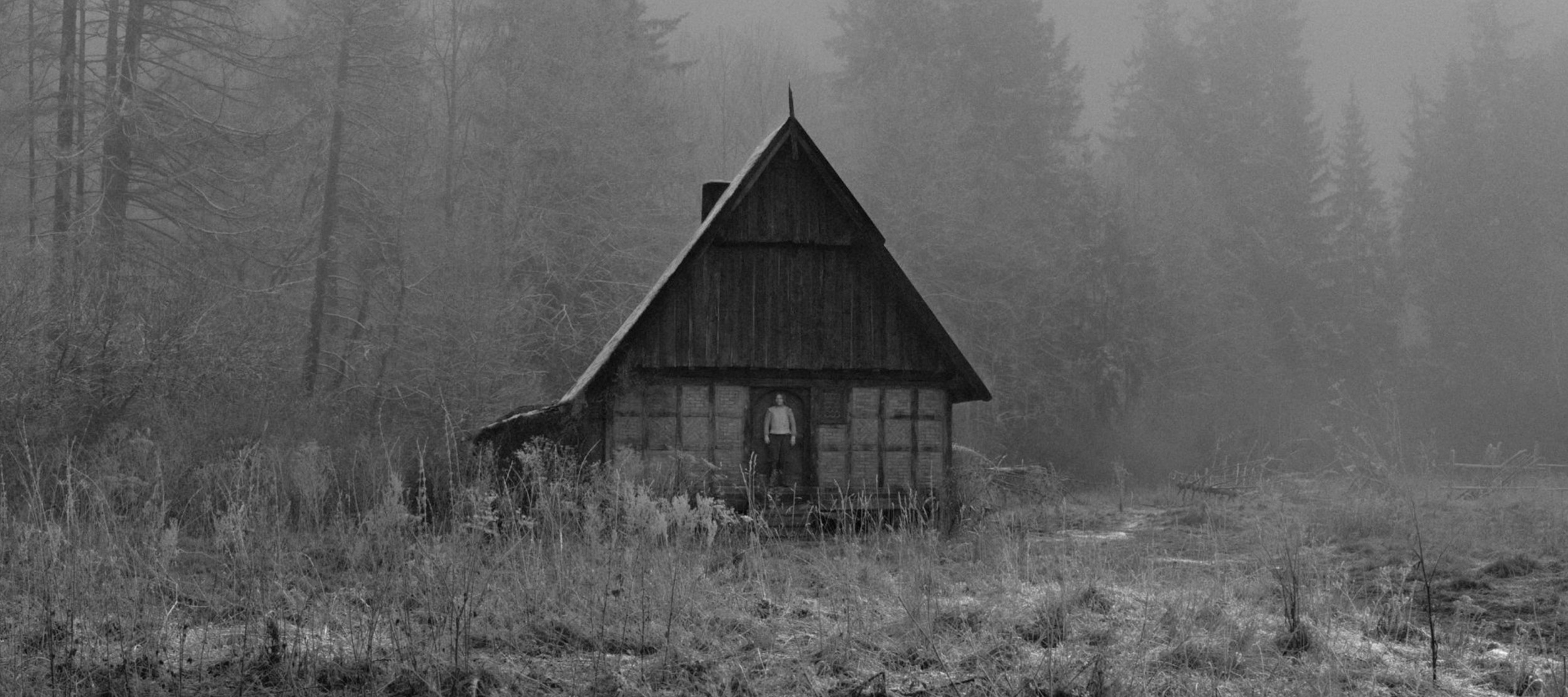
Gerald Kerkletz works the camera, capturing the black-and-white photography, and the resulting images are wondrous. The cinematography distills the rough life that this setting requires. Simply surviving is no mean feat, as the land, weather, and wildlife all pose a threat as strong as human warfare. Nevertheless, the imagery is often staggering in its beauty, whether capturing the storm blowing through the woods or a vibrant night sky.
While firmly rooted in its setting, Rose is clearly aware of contemporary discussions on gender and societal roles. In discussing the film, Schleinzer notes that “the present becomes more legible when viewed through the lens of the past.” Here, the emphasis foregrounds freedom and the rejection of gendered expectations before questions of sexuality. Rose observes the restrictions that come with being a woman and decides she’d prefer the agency afforded to her by acting as a man. Schleinzer sums it up: “Surrounded by irrefutable definitions in her time, Rose begins to tell her own story.” What Rose argues is that, while the self is always constrained to the world, the restrictions of that world have a bit of give to them. Rose makes her choices, chooses the life she desires, and the world around her manages to accommodate her. At least to a point—every action has its consequences, of course.
Rose writes herself beyond her limits, and this is what makes Schleinzer’s film ultimately as transcendent as it is earthy: it’s about the “miracle of being new” that occurs with each birth, with every springtime, with every choice we make to reshape ourselves. And we all make such choices, small or large. “Impossible is but a word,” the narrator tells us, almost in the tone of a parting blessing.