‘Hamnet’ Interrogates the Pain of Not Being
When Will (Paul Mescal) first meets—or, at least, has his first real conversation with—Agnes (Jessie Buckley), she asks him for a story that moves him. Perhaps he has the seductive power of unfading love on his mind, because he chooses the tale of Orpheus and Eurydice. The musician who would broach the underworld for the sake of reuniting with his lover certainly evokes a romantic earnestness, but it’s also shot through with melancholy and loss. As Will describes Orpheus’s hesitant journey back, he notes that the tragic hero can’t hear Eurydice’s footsteps behind him: “All the rest is silence.” Silence, in fact, is what the musician is left with.
The tale is effective enough to become a marker in the budding romance between Will and Agnes: shortly after Agnes becomes married, they challenge their parents’ anger and get married. But time will reveal that it’s an omen of far more: of death, of loss, of silence.
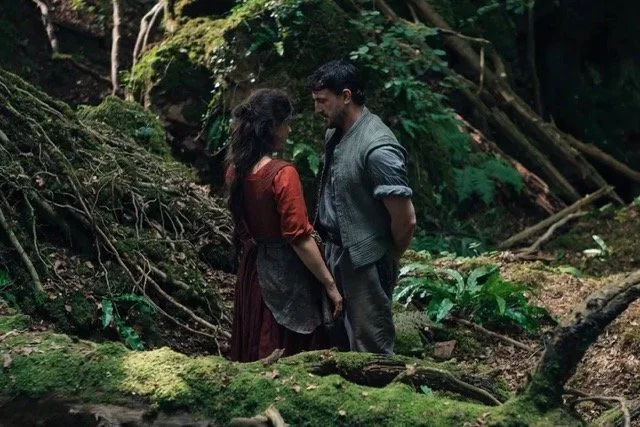
Chloé Zhao’s Hamnet resounds with warnings and omens. It is no spoiler to note that Will is William Shakespeare or that the central hinge of the story is the death of Agnes and Will’s son, Hamnet (Jacobi Jupe). Zhao, who previously directed The Rider and the Best Picture winner Nomadland, adapts Hamnet from Maggie O’Farrell’s novel (O’Farrell also is credited as co-writer and producer). The story’s focus is primarily on Agnes, a woman characterized as more of a forest nymph than a typical female member of sixteenth century England. She spends her days in the field with her hawk or in the woods gathering herbs and plants. Most people are wary of her, and she of them, but she forms a quick, passionate connection with Will.
The arc of the film is straightforward, even with only cursory knowledge of the novel or plot details. This is a harrowing emotional experience, soundscaped as much by the howls of childbirth and grief as by Max Richter’s score. Zhao brings her eye for natural forces (and the unnatural senses they can spark), adding needed layers to the screenplay. She frames the forest as a dark and mystic force, and water acts as nature’s messenger when it creeps under doorframes. But first and foremost, this is a showcase for the talents of Buckley and Mescal, both of whom have had ample opportunity to display their skills. Even with familiarity, though, the acting of Hamnet impresses.
There’s a push and pull to Hamnet that leaves me both emotionally distanced and affected—an odd combination. The tale of Orpheus is one example, but there are many others I could have opened this review with. The very first shot would have been another fitting one: Łuckasz Żal’s camera slowly tilts down the trunk of an old, massive tree, to finally alight on Agnes curled up in the moss in her dark red dress. From here on out, Hamnet will be a journey downward. Or Agnes’s prophecy that she would have two children beside her at her deathbed, creating a mathematical issue when the twins, Hamnet and Judith, make three. These are only a few of the ways that Hamnet heavily foreshadows the central pain of its story, never letting you forget where even the happy moments are heading. Almost every image is freighted with the loss to come.
Hamnet’s death is no twist, but the tonal signifiers are a little too heavy handed. Likewise, on the other side of the death, some of the scenes as Agnes and Will struggle with their grief are too on the nose, such as when Will stares down at the Thames contemplating suicide. Whether to continue living or shuffle off this mortal coil is a question clear in his eyes alone, but the script has Will verbally begin the famed soliloquy. In these moments, the movie’s presence and structure is felt—the audience can sense the movie wanting to make sure we’re ready to cry. It pushed me away, made me pay more attention to what the movie was wanting me to feel than to the actual movie.
But then the camera is simply set on either Buckley or Mescal as they process and mourn their son, and—despite all the ways the movie had formally distanced me—I was suddenly tearing up. Buckley is all parental fury and agony, twisting shrieks and stone gazes in her pain. Mescal shows Will panicked, looking for any way to deflect before realizing he can’t and that all he can do is crumble. Together, Buckley and Mescal create a gymnastics of grief. Their displayed pain cuts sharply through the reluctance to be carried by the film’s emotion. Jacobi Jupe is also worth noting as young Hamnet. In limited screen time, Jupe gives Hamnet a full, distinct personality, mixing his father’s playfulness with Agnes’s bravery.
How gripping and poignant Hamnet is for you will, in all likelihood, revolve around its finale. Again, there’s not very much to require a spoiler warning, but I won’t describe it. It’s the swing-for-the-fences moment that crystallizes all of the film’s soul. It worked again for me—the potential of the scene is fiercely manifested by the performers. I still have a few reservations about Hamnet’s screenplay. But I can’t deny the emotional resonance it achieves. On the whole, the visuals go where the script can’t, and the acting goes even farther.