Projection, Framing, and ‘Miroirs No. 3’
Schramm Film
One of Christian Petzold’s dominant fixations is projection, the ways that people project onto someone else the thing they believe they need. The German filmmaker (Phoenix, Transit, Afire) turns his gaze on this human impulse that is itself expressed predominantly through gazes. The screenplays Petzold creates are often sparse, quiet affairs whose summaries whisper to audiences the possibility of a thriller or noir film. Sometimes they are indeed just that (though always much more than just). But often Petzold’s films unreel into something less definable and altogether more psychologically tuned. They aren’t out to provide salacious excitement, but are rather about recognizing our tendencies to manipulate others for our own ends, whether we intend to or not.
This characteristic runs throughout Petzold’s Miroirs No. 3, a film whose inciting incident belies its quieter concerns. As Miroirs opens Laura (recurring Petzold collaborator Paula Beer) is on her way to a trip with her partner, Jakob (Philip Froissant), and a couple of his friends. From the little that we observe, this relationship is on thin ice, and Jakob blows up at her when she declares she doesn’t want to go. Reckless with anger, Jakob crashes the car along a village road. He’s killed instantly; Laura miraculously survives with little injury, though very shaken up. The first person on the scene is Betty (Barbara Auer), who hears the crash from her nearby house. It’s Betty who helps Laura and talks to the police and emergency responders when they arrive. Despite having no connection with Betty, Laura asks to stay at her place as she recovers instead of returning to Berlin, and Betty—though surprised by the request—accepts.
As Laura heals the two women bond and form a friendship. Betty certainly doesn’t seem to mind having Laura around, and Laura repays her generosity with painting, gardening, and cooking. Not much is said about Laura’s past other than that she is studying as a pianist in Berlin (the film’s title refers to a portion of Maurice Ravel’s an early twentieth century piano suite by Maurice Ravel), but this time in Betty’s village fashions a mental retreat that she is eager to embrace. Betty’s husband and son, Richard and Max (Matthias Brandt and Enno Trebs), are soon introduced, as well. For all the joy that these two women express, however, there’s clearly something else that remains unspoken. The first dark omen occurs when Betty addresses Laura as Jelena—a moment that they each choose to immediately forget. And when the men first come to the house for dinner, they are visibly perturbed and unsettled by what’s going on.
So what is going on? Miroirs doesn’t hold that card up its sleeve for a shocking twist—as the story unwinds, the fact lying beneath Laura and Betty’s connection is secondary to tracing the shifting dynamics between them. Everyone has their small secrets, but no one is very good at hiding them. The mystery of the past flows into the mystery of identity and personality. Who is Laura? We hardly know. Who is Laura to Betty? And does Laura accept that new role, recasting herself to fit the longing of this other woman?
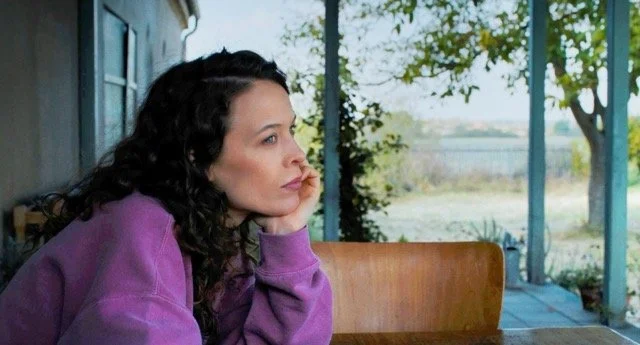
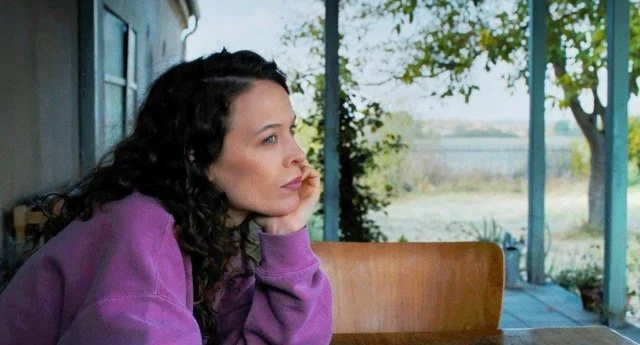
Much of the film is told without exposition, imaged in long gazes and prying observations as Betty slides between care and creeping protectiveness. Petzold, working with his persistent cinematographer, Hans Fromm, frames space in a way that distances each character from each other and from the audience. You are never sure what they’re contemplating. The shots are architectural but never clinical. Fromm is an adept when it comes to suffusing spaces with natural lighting, and his skills are front and center in Miroirs. I’m not sure there’s an active cinematographer who can better capture the spirit of sunlight through a curtain into a bedroom.
Views of the German landscape through windows is a bidirectional motif. First, it locates the characters and the viewers as voyeurs. They gaze at the land much as they gaze at each other, attentive to any signification or revelation that would orient their attitude. Gazing through a frame can be a lot of things though: a landscape through a window frame echoes our relationship to works of art, hinting at appreciation and contemplation; but it can also be a covert act of spying. Second, the architectural frames also are an intrusion, an obstruction. While the window enables vision, it also blocks out a far greater amount than it reveals. Gazing through a frame never reveals a complete truth.
It’s a fitting visual metaphor for the forces of projection that Petzold unleashes and interrogates in Miroirs. We want to understand Laura and Betty’s past, but our attempts to do so are obstructed; such matters lie outside the frame. Laura and Betty, meanwhile, seem caught between competing desires to see each other clearly and content themselves with their own framing of their relationship. What Miroirs does make clear, despite all of its evasions, is that healing is jagged work.