The Fantastic 4: First Steps Isn’t Quite a Giant Leap
The opening of Matt Shakman’s The Fantastic 4: First Steps is not an explosion or an ominous foreshadowing of villainy to come (don’t worry, we’ll get there). It’s a small scene between Pedro Pascal’s Reed Richards and Vanessa Kirby’s Sue Storm, and it injects more human emotions in the first two minutes than most superhero movies of our era achieve in three hours. The scene is an indication of what Shakman is aiming for in the latest attempt to adapt the Fantastic Four for the big screen. First Steps contents itself on being about family and real community and heralding “a small group of thoughtful, committed citizens.” The return of superheroes as sincere protectors? Welcome to 2025.
Our heroes still have to be super, of course, with all the baggage it brings. The Silver Surfer (Julia Garner) turns up in earth’s (or Earth-828’s) atmosphere hailing the arrival of Galactus (Ralph Ineson), an alien god or sorts who suffers from “relentless, eternal hunger.” And the only prescription is to eat more planets. He’s decided his next course shall be earth, so the resident billions are exhorted to make peace and enjoy their last days with their loved ones. None of it sits too well, so the Fantastic Four trace the Surfer’s path back to Galactus and confront him. He does offer them a way out: If Reed and Sue will offer up their soon-to-be-born son, Galactus will spare the earth.
The stakes are set. Or rather, they’re pretty much unchanged from the last wave or two of superhero films. The entire planet is in peril, again. Yet despite its literal world eating stakes, First Steps keeps its heart nicely focused. Joining Kirby and Pascal are Ebon Moss-Bachrach as Ben Grimm (aka the Thing) and Joseph Quinn as Johnny (the Human Torch). Johnny is traditionally the source of snark for this crew, and Quinn gives a serviceable performance, but the other three give their characters depth and nuance. Exuding sensitivity just below the surface is right in Pascal’s wheelhouse, making him a great sparring partner for Kirby’s impassioned delivery. Moss-Bachrach goes understated with Ben Grimm, a smart decision that gives him calm warmth, as though he’s the real stability for this found family. Paul Walter Hauser must also be mentioned, for he munches delightfully on the brief screentime his Mole Man has.
The script eventually deflates into cliched threats and vows, but the actors by then have done enough work to imbue these heroes with real personalities. Shakman and his writers avoid the casual snark and the tiresome Do you see what I did there? jokiness that has dominated Marvel for too long. Like James Gunn’s Superman, also from this year, this film is a return to the romance of superhero movies: the hope of noble figures willing to sacrifice themselves for the good of humanity, the thrill of a world always encountering bizarre discoveries. (Unlike Superman, Shakman doesn’t swing for Gunn’s cruel flippancy. Gunn’s sense of humor has many fans out there, but I find it distancing. In the end, I prefer this flavor of genuine warmth.)
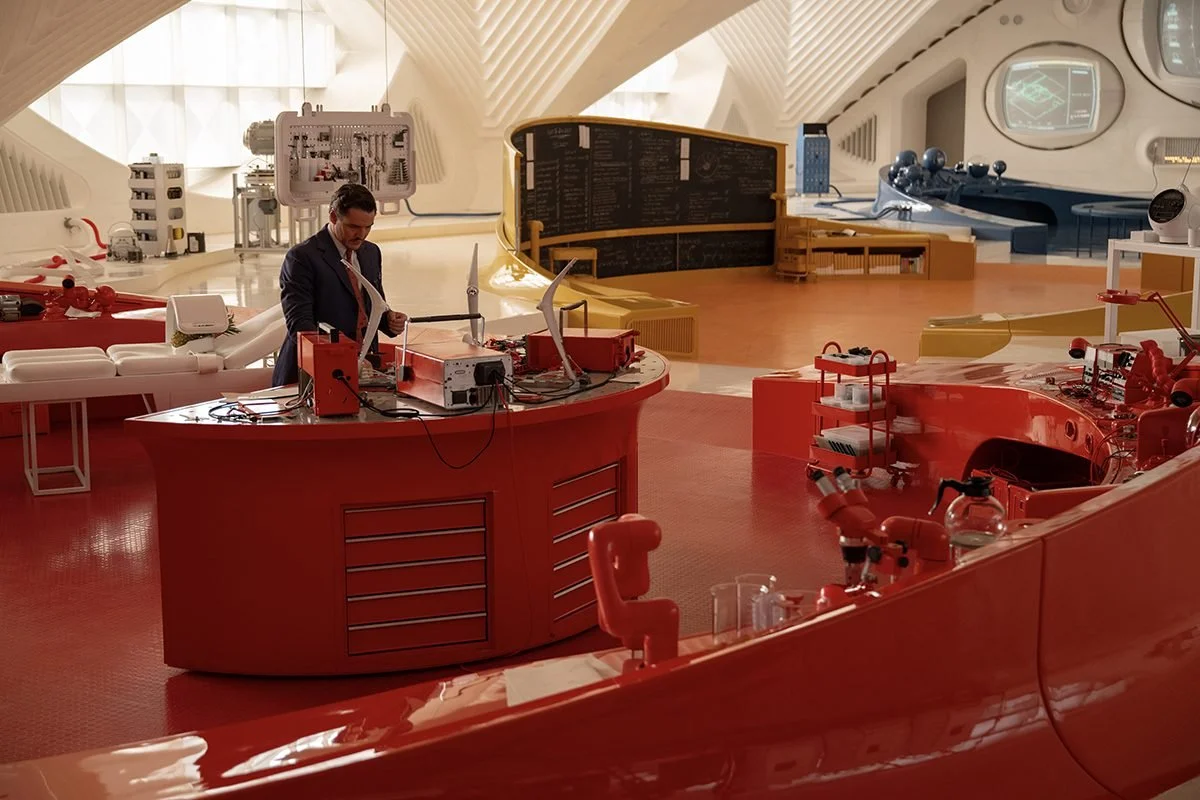
Similarly worth calling out is the look of First Steps—the film is bathed in a retro sheen, from its Tomorrowland city planning to the Four’s abode. The sets are electric with vinyl reds, bright inky blues, and enameled orange; plus they generally seem like real sets. It’s a welcome change from the dim purple-blue-orange CGI palette that has been made the standard for signalling that we’re now in the multiverse (a fate which Gunn’s Superman isn’t entirely free from). Brad Bird’s The Incredibles undoubtedly pulled a lot of inspiration from the Fantastic Four, so perhaps it’s only right that Shakman returns the favor here. In fact, at its best First Steps feels like a live-action version of The Incredibles, which is both to its credit and also finally condemns it by constantly reminding you of those movies. The space scenes make the unexpected decision to draw on Christopher Nolan’s Interstellar. It’s most obvious in a black hole encounter, but there are also nods in shots from the heroes’ spaceship and their tricky attempts to dock with a faster-than-light engine.
If this all seems fairly praiseworthy, that’s in part because making the typical complaints about superhero movies has begun to approach the drudgery of the MCU, itself. First Steps doesn’t concern itself with too much lore or tie-ins, but it still has the MCU DNA: too much city destruction; unnecessary, cataclysmic stakes; CGI energy battles; genuflection to fan service. It’s all still here, the gravity that no contemporary superhero film can escape (outside of Matt Reeves’ The Batman, at least). It’s a predictable arc with heavy handed moments of disaster and redemption, with clear signposting for its later beats.
Still, I appreciate the movie that The Fantastic 4: First Steps is trying to be. It has a restraint and solemnity, but it’s generally free of false grandeur. This is a movie that features yet another massive extraterrestrial stomping through New York City, casually demolishing buildings as he goes. But somehow, the movie has a confined feeling, closer at an emotional level to the drama of Raimi’s Spider-Man than any Marvel movie of the past decade. It’s more interested in interpersonal relationships than energy beams, even if it ultimately resorts to those.
Gunn’s Superman and First Steps have me thinking about the idea of diet. The endless cavalcade of Marvel and DC movies have generated so much exhaustion that it feels hard to muster up the energy to consider any of them. (We do not have the relentless hunger plaguing Galactus.) In the context of this weariness, both of these 2025 films have felt a bit restorative. But it’s like eating good fries after eating a bunch of candy—comparitively it feels substantial, but in the aggregate it only exacerbates how bad I’ll feel. If we received one or two superhero movies of this quality each year without four or more execrable ones, they would stand in much higher regard. As it is, it’s hard to look at these and feel enlivened by the return of great superhero movies when the landscape remains so blanketed by poor ones.