‘The Christophers’ Remains Unfinished
Department M
Steven Soderbergh is a persistently efficient filmmaker, and his latest movie, The Christophers, wastes no time communicating its set up and stakes. Art restorer (and food truck laborer) Lori Butler takes a call from an art school acquaintance, Sally (Jessica Gunning). Sally and her brother, Barnaby (James Corden), are the children of the famous—and perhaps infamous—painter Julian Sklar (Ian McKellen), but they’re fearful that Julian’s reluctance to complete any more paintings will leave them with far too little extraneous wealth once he dies. So they offer Lori a proposition that is as ethically dodgy as it is financially compelling: Forge and finish his unfinished series so they can be discovered and auctioned off after his passing.
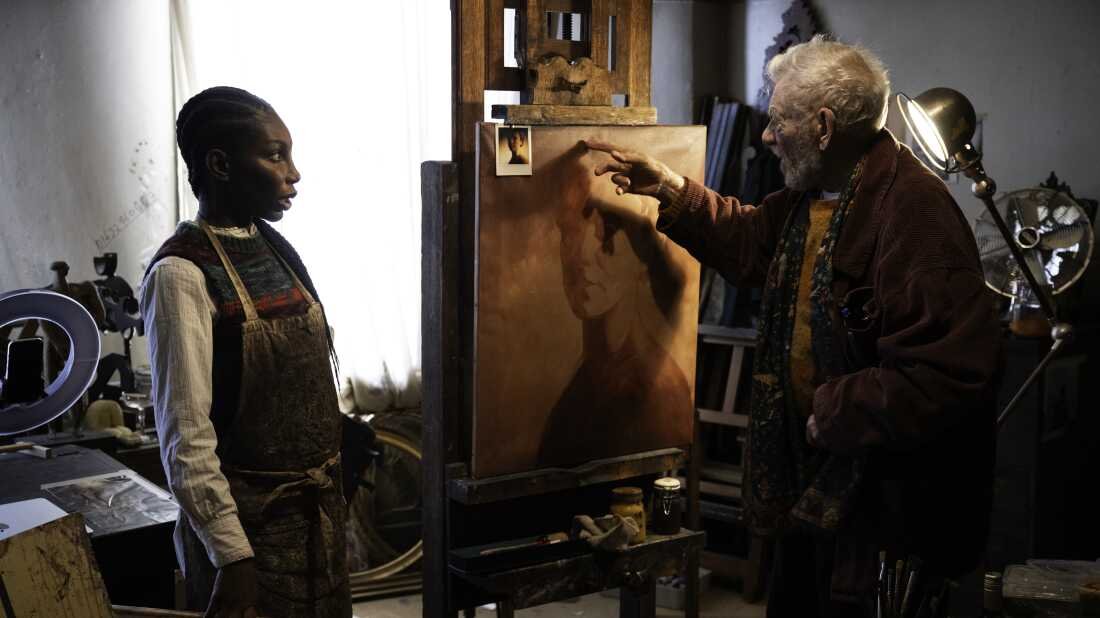
Lori is understandably reluctant, and not only because of the moral qualms. She has her own grudge with Julian Sklar that becomes apparent over time. Nevertheless, she entertains the idea enough to show up and interview as his assistant. Julian’s not doing so well these days, seemingly confined to a flat in disarray and reliant on transcribing online video notes at the request of any parent or art school hopeful who will pay the £150 fee. All he wants is “to last in the mind of others,” but the exact quality of his legacy is uncertain. The unfinished paintings forgotten in an upstairs bathtub are the Christophers, portraits of a man Julian loved and lost. Returning to those portraits would require returning to those emotions—a confrontation Julian may never be ready for.
The first meeting between the two reveal the film’s true focus: this is not about forgery or an art heist; it’s about the collision of these two souls. The divide between Julian and Lori is immense. He’ll hardly touch a canvas, but Julian has a spectrum of frustrations to give color to his view of society. It’s a little ambiguous, but talentless hacks, critics, rich collectors, dreaming children, and women in general all seem to have received his ire at various points. Lori barely gets a chance to speak amid all of Julian’s bluster.
But there’s something off here, and what was first perceived as efficiency begins to feel like a simple line drawing. The grumpy social outcast being saddled with a younger, impassioned person isn’t exactly new creative territory. Gran Torino. Up. A Man Called Otto. Hunt for the Wilderpeople. I kept expecting Soderbergh to unravel the formula, to turn it into something artful, to bring a new color palette to the canvas. Instead, it mostly paints by number. The movie doesn’t really get moving until Lori picks up a brush close to an hour in. The energy livens for a brief time, but it falls back into sedate predictability. The emotional moments of clarity and revelation for the characters are never fully earned and thus always insubstantial.
The issue is in the design itself: the script. Neither McKellen or Coel—who are both capable of delivering captivating, refined performances—are able to transcend the screenplay and give real life to their characters. McKellen is an impeccable talent, of course, and it’s never a bore to watch him onscreen. But Julian’s dialogue is so rote and uninteresting. Perhaps we will never tire of giving a beloved, aging performer the chance to chew scenery as a garrulous grouch, but we can certainly craft more rounded roles. The obvious condition of Julian’s character appears to be genetic. We only need ninety seconds with Sally and Barnaby to distill their purpose in this narrative. Are they greedy? Yes. Are they groveling? Also yes. It’s efficient, but with the cookie-cutter efficiency best suited for an older era of Disney films.
On the other hand, Lori is relegated to non-presence for far too long. Her interview with Julian should be the moment where the film becomes a confrontation between the two of them, but she’s silenced as Julian answers his own questions before she can utter a syllable. Coel also just starred in David Lowery’s Mother Mary, and in that film she brought a dexterous, ascendent spirit to her character. Lowery’s script was robust, and Coel reveled in every word of it. But The Christophers leaves her set aside and forgotten for much too long.
Soderbergh doesn’t know how to make films badly, and The Christophers is no exception. But what should become a portrait of Julian and Lori never gets beyond a thin sketch. The style is simple, the dialogue never as sharp as it should be, the moments of development too easy to be believable. Much like the paintings in Julian’s bathtub, the film feels unfinished. A new Soderbergh is always worthy of attention, but I fear this one won’t last in my mind.