Violence Ages Poorly in ‘Wild Horse Nine’
Searchlight Pictures
This fall is proving to be a bull market for movies where you know up front just what you’re going to get from a director. Do you enjoy Inarritu’s prickly, stylish discourses on art in a fragmenting world? Digger’s got what you’re looking for, with a boisterous Tom Cruise performance, to boot. How about Sorkin’s smooth (no prickliness here), snappy dialogue tackling our modern societal ills? Never fear—The Social Reckoning has arrived. But what if you’re looking for something altogether harsher? Still snappy, though, but with considerably less optimism? That’s Martin McDonagh’s cue.
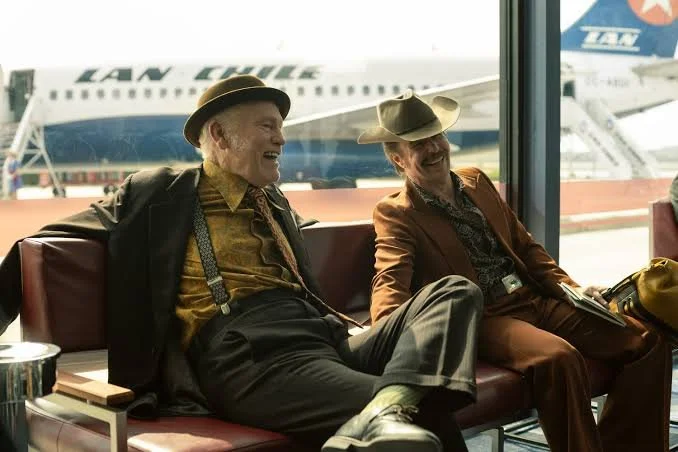
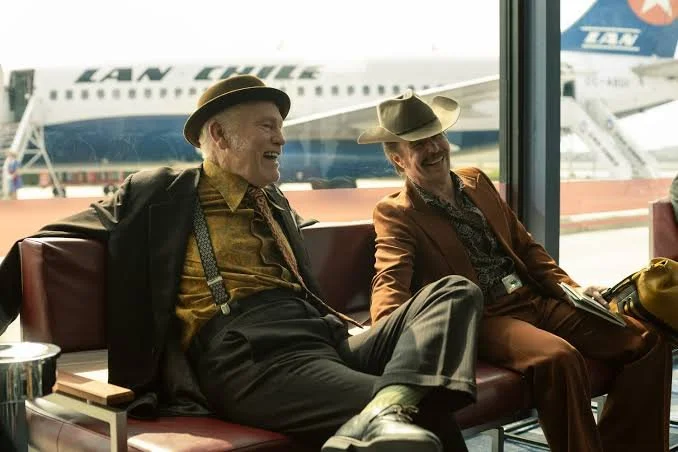
At the heart of McDonagh’s Wild Horse Nine stands Chris, an aging CIA assassin played by John Malkovich. The year is 1973, the location Santiago. Salvador Allende, a socialist elected to the presidency in 1970, still maintains popular support among many of the younger Chileans. He isn’t so well liked by the US, however, and toppling stable nations happens to be Chris’s area of expertise. He was on the ground in the Congo when Patrice Lumumba was murdered, though he swears he had no involvement. He was also in the vicinity of Dallas in November of 1963—though he’s much more coy about his role there.
Chris isn’t the same hitman he once was. He only has a short time left to live, and to make matters worse, his memory is rapidly diminishing. As his cognitive grip loosens, he begins to tell stories to anyone who’ll listen. Unfortunately for his partner, Lee (Sam Rockwell), many of these stories are true. Lee and Chris are sent on a bit of a vacation by their boss, MJ (an enjoyably grumpy Steve Buscemi), to Easter Island—Rapa Nui, that is. But MJ wants Chris dead. And Chris, well, he wants to be dead. It’s why he asked Lee to take him out to Rapa Nui: so that Lee could take him out, period.
Structurally, Wild Horse Nine follows a very similar formula to McDonagh’s In Bruges, although it’s a grayer, sadder version of it. The style, too, is paradigmatic for McDonagh. These are violent men with belligerent personalities who mask their regret under whipcrack insults. Malkovich is the right lead for this script, pulling from a deep well of sadness tinted with wistfulness. Chris is still a man of bloodshed, but he has many moments of somber emotional power. Rockwell is always an energizing presence, but the role does little to stretch his talents.
At the end of the day, if you like McDonagh—and specifically his work in In Bruges and Seven Psychopaths—you’ll find Wild Horse Nine to be another strong entry in his oeuvre. Or if his caustic blend of humor and brutality isn’t your cup of tea, you’ll want to skip this one. For my part, I’ve never been drawn in by his acerbic sensibilities. His best film, by far, is The Banshees of Inisherin, which traded the cruel wit for relational suffering and exemplified a far wiser filmmaker. Wild Horse Nine is too tethered to the In Bruges formula. McDonagh’s inveterate misanthropy remains; he’s just much more sad about it.
I can’t escape a sense of dissatisfaction with this misanthropy, and I can’t help but wonder if we’ve moved past finding such transgressive edginess becoming. Wild Horse Nine wants empathy for assassins, but this loyalty shifts its criticisms off target. Chris seems sad about hurting others, but he indicates no regrets about tearing apart nations that have finally achieved progress or peace. No matter how charming Malkovich’s performance is, Chris is a cut-and-dry perpetrator. This conflict sucks away the sadness that McDonagh wants to convey, and it effaces the commentary that might otherwise be worth hearing.