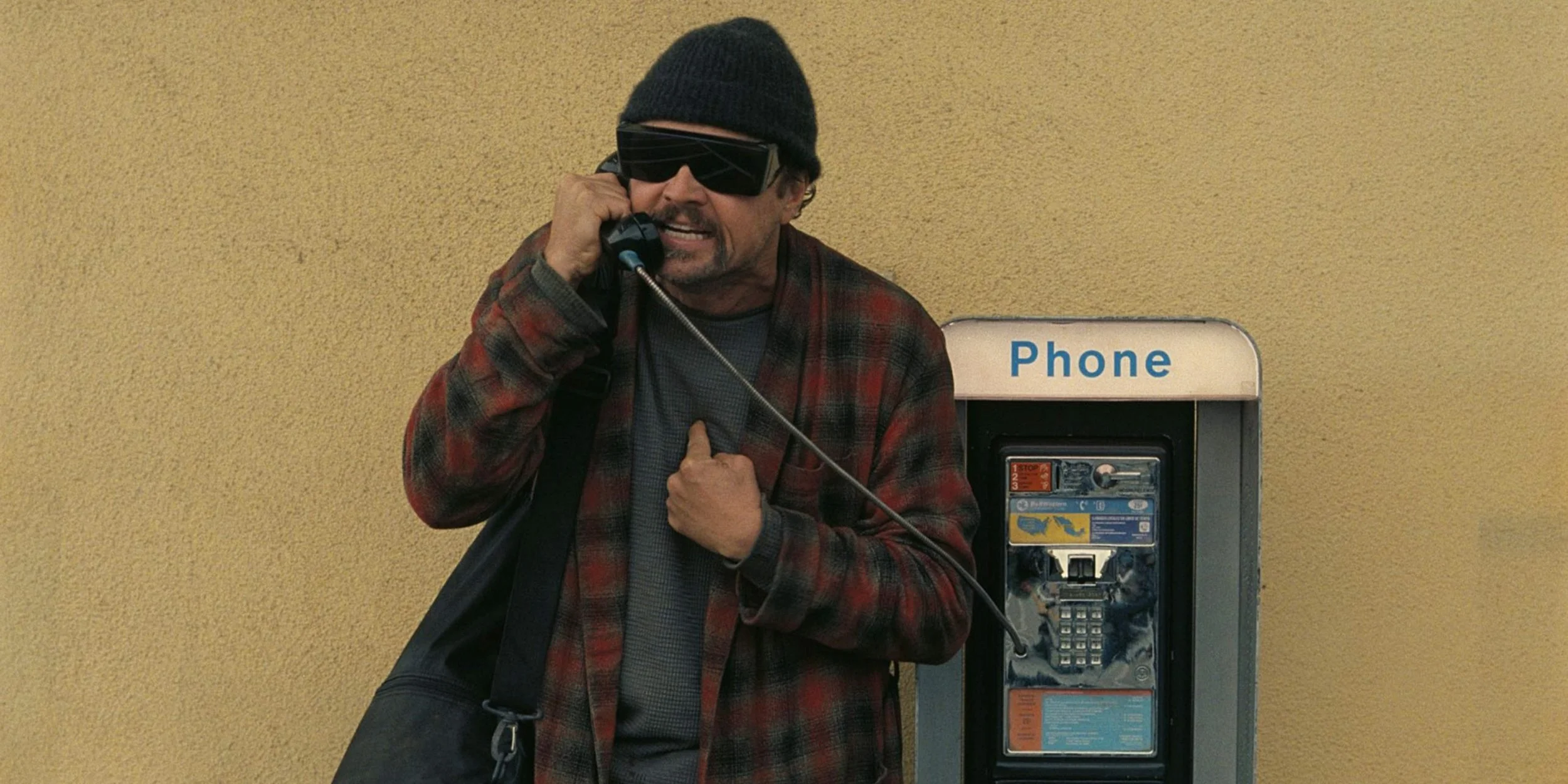
One Battle After Another Is a Furious Film for an Unsubtle Time
Here’s a hypothesis: Whether or not it’s the best film of 2025 (as many film critics’ groups have praised it), Paul Thomas Anderson’s One Battle After Another definitively speaks more loudly and decisively to our moment than any other from this year. Need some evidence for such a claim? The very first minute opens on a US immigration detention center near the US-Mexico border.
Anderson’s one of the greatest directors of the last three decades, and he makes it clear that this is no time for subtlety. It’s a bit unexpected, as Anderson’s films are rarely set in the current day—There Will Be Blood, The Master, Phantom Thread, Boogie Nights, and Licorice Pizza are all period pieces of a sort. He’s always filled his movies with substance (if such aspects aren’t always the main thread), but he’s tended to orient his commentary obliquely, inviting meditation and interpretation. While there’s already proven to be much to discuss and debate with One Battle After Another, this movie is a clarion call for action.
We do open in the recent past, as the revolutionary group the French 75 breaks into the detention center to free the immigrants being held. Our protagonists Bob (Leonardo DiCaprio) and Perfidia Beverly Hills (Teyana Taylor) are there to effect the jailbreak, with Bob acting as the demolitions expert. Perfidia and Bob are also lovers, and their names tell you as much about their characters as the first few minutes: Perfidia is bold, memorable, and self-assured. Bob is committed to the cause, but he’s also a bit of a wet blanket compared to his more fervent compatriots. Their counter-state actions make a mark, but they also place them under the sinister gaze of Sean Penn’s Col. Steven Lockjaw (yet another on point moniker). Lockjaw becomes equally obsessed with disrupting the French 75’s operation as he is fixated on Perfidia, herself.
Lockjaw begins targeting the organization, arresting some, killing others. Shortly after Perfidia gives birth to Willa, the pressure becomes too much, and she flees under a new identity, abandoning Bob and her infant daughter. The revolution has dissipated; the powers at be continue their iron rule.
We jump ahead sixteen years and reconvene with Bob and Willa (Chase Infiniti), now living a normalish life. The rebel days are over for Bob (never a self-starter to begin with), who has adapted to his midlife uselessness by becoming an inveterate stoner. But Lockjaw’s still on the warpath, and soon Bob and Willa find their existence threatened yet again. Beyond the military, itself, the remnants of the once revolutionaries have to contend with the Christmas Adventurers Club, a shadowy white supremacist sect considering Lockjaw for membership.
DiCaprio’s performances haven’t always captured my admiration, but his role here is his best in quite some time. Between this and Scorsese’s Killers of the Flower Moon, I’d contest that he excels when his agency is sidelined a bit, when he’s paired with characters more enterprising than his own. He’s great at being past his prime, at being just on the outside of the action, at being a little bit of a fool. Taylor’s Perfidia has drawn a fair amount of debate for how it hinges on Black female sexuality (and its objectification by white men), and there are worthy reflections on the role her character plays, but her no-holds-barred performance is above reproach. She makes no apology or hesitation as Perfidia, throwing herself into Perfidia’s radical attitude and view of herself. Penn renders Lockjaw as the most tense man to walk the earth, scrunching his shoulders, all taut and deranged.
One Battle After Another is adapted from Thomas Pynchon’s novel Vineland (making this Anderson’s second Pynchon adaptation after Inherent Vice), but many of the details have been reworked, making it equally possible to view One Battle After Another as an adaptation of our current sense of reality. One Battle looks at the American landscape and sees a world where everything is a cabal, where the cults of power tread heavily on the lives of individuals, where the government generates its own excuses for placing people under its sword. It’s also a world that creates its own revolutions and never completes them.
Like any Anderson movie, One Battle is expansive and discursive, winding in all directions to create not just a narrative, but an envisioned world. Along the way, Bob will cross paths with Willa’s sensei Sergio, and you get to watch with delight as Benicio del Toro rips to shreds the hopes of anyone else to claim Best Supporting Actor. Del Toro’s Sergio is a calm, playful, caring presence in a film stretched with tension. We also meet a convent of nuns who, sure enough, are also revolutionaries. But even as its gyre widens, Anderson holds the center on target: white supremacy in power, whether overt or under the radar, must be uprooted.
What One Battle depicts in a way few films have is the Janus-faced nature of such wickedness. Lockjaw and the Christmas Adventurers Club are shown to be entirely pathetic—their meetings and goals resemble nothing so much as an office boardroom, as though that’s the epitome of their dreams. Yet they are no less destructive or powerful. Violence is always a tool at hand for them when “softer” levers of power just aren’t doing the trick. They deserve derision and fear in equal measure.
The filmmaking is excellent, propulsive. Jonny Greenwood’s score is flexible, at times catchy, at times disorienting, at times disquieting. Early on the camera is close to the characters; while it eventually broadens out, the tension has by then permeated the atmosphere to sustain the rest of the movie. There’s a car chase here that somehow finds a new visual method, despite how many chase scenes we’ve seen across films: rocketing through the northern California hills, the camera holds shaky and low to the ground, careening over each hill before diving back down. It limits the view, making each image a question of what is to come. You don’t know how long it will go on for, or how suddenly it will come to a halt. I suppose the same is true for the societal status quo.
All of the tangents, the humor, and the tension cohere to make the movie at once an excellent thriller and an impassioned jeremiad for the state of the world. One Battle After Another is a furious film for an unsubtle time. The revolution is never finished, but it is always regenerating.