StudioCanal
On the fifth of September, 1989, Daniel Day-Lewis walked off the stage of London’s National Theater during Act I of his performance as Prince Hamlet. He did not return for continuing performances. This occurrence alone could provide a thrilling fixation for a movie centered on art, performance, and the bruising weight of Shakespeare’s play; in Simon Stone’s Elsinore, it merely clears the stage.
In the wake of Day-Lewis’s departure, British actor Ian Charleson stepped into the infamous role. A role infused with monumental expectations that were only made more staggering for the necessity of filling Day-Lewis’s shoes. Charleson was a significant, recognized talent—both for roles in the theater and for his turn in the film Chariots of Fire—but Day-Lewis was entering the earth-shattering phase of his career. Again, it would be easy for a movie to emphasize this in Charleson’s story: the overcoming of these burdens to stage a memorable performance. But there were much greater pains weighing on the actor.
Charleson was HIV positive and, as he was preparing for and performing the role in Hamlet, battling with AIDS. Despite the best attempts by his doctor to dissuade him from continuing the excruciating performance, Charleson insisted on taking the stage. For him the question of whether or not to act bore the same gravity as to be or not to be. To be required the chance to act; otherwise the being wasn’t worth it all.
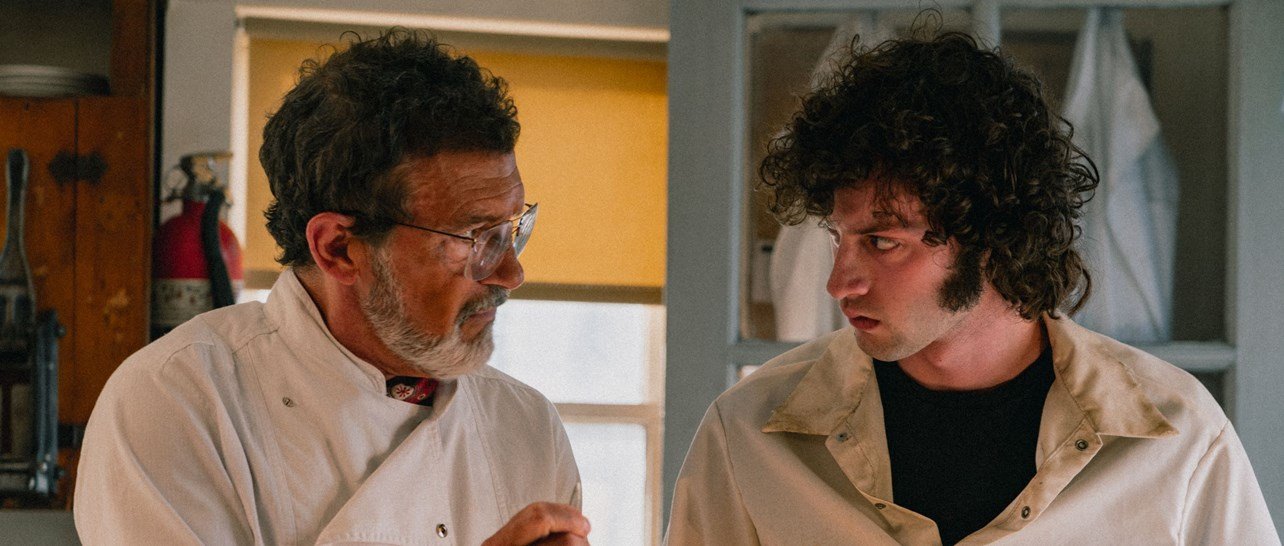
Andrew Scott plays Charleson as he wrestles with Shakespeare and the increasing imminence of death. The film is about a staggering performance (Ian McKellen praised Charleson’s run), and it contains a staggering performance to match. Scott’s light has been waxing for some years now, and Elsinore is not so much a full arrival as a full throated shout of his talents. The minefield that this script could become is deftly navigated thanks to his presence. It’s a clear acting awards showcase—but that doesn’t make it any less impressive. He’s an actor playing an actor; but he brings a naturalness to Charleson’s life such that it never becomes conspicuous.
Stone’s film spends as much time in hospital waiting rooms as it does on stage. This is to its credit. It could spend more time in the former, in fact. The impending doom that suffuses Hamlet is paralleled by Charleson’s battle against such a destructive disease. The movie’s piercing strength is that Charleson isn’t fighting to survive: he’s fighting to declare his personhood, to embrace and expose vitality in the face of rampant death.
Whether or not the wider culture knows it, the disease that’s plaguing Charleson is eroding everyone else. Much of Britain (and no less America) was hard at work turning its gaze away from the hell of AIDS and the humanity of its victims. And while the performance scenes, with Shakespeare’s unparalleled poetry, are clear attention-getters, the movie is best when considering the public’s habituated denial. Derek Jarman (David Dawson) is the clarion voice, relentlessly pushing Charleson to go public with his sexuality and his diagnosis.
It is also worth taking a moment to praise the work of cinematographer Mike Eley. Much of the film is spent indoors, and Eley stages remarkably lovely lighting slanting into Charleson’s apartment. Dim light, too, is a wonder: the night photography is just as breathtaking. The result is a film that is as beautiful to behold as it is to listen to during Scott’s work with beloved lines.
Much praise thus far, yet Elsinore also suffers its share of slings and arrows. First, a film staged around a staging of Shakespeare is always a gambit. Last year’s Hamnet in fact played the game with this very play. These films are inevitably set upon a razor’s edge that determines each viewer’s appreciation or frustration. One of the questions that kept returning as I watched Elsinore—much the same as when watching Hamnet—is whether the film is conveying its own emotional power or outsourcing that potency to Shakespeare’s play. It’s a question woven into the very structure of Hamnet, and that movie hit me forcibly.
The balance does not quite fall in Elsinore’s favor for me. This is due to both prevalence and emphasis. The film repeatedly cuts between Hamlet’s desolate beauty and Charleson’s life, even when it comes to characters talking about the play, such as when one explains that “it’s about being alive and becoming dead.” It’s a beautiful sentiment that sums up both works at once. It would stand taller had it been given space rather than being crowded out by so many similar lines. The frequency of these moments is simply unnecessary, and it becomes even more obvious in a finale which cuts between brief snippets of shows as Charleson’s health gets worse. By comparison, Hamnet aligned all this intertextual connection to the explosion of one extended scene; Elsinore plays a highlight reel in order to capture so many varied lines about portents, doom, and decay. While the former worked for me and the latter stumbled, the opposite could easily be true for you. Lastly, if you enjoyed the forceful use of Max Richter in Hamnet’s finale, you’re going to love the loud score here.
The other issue is, regrettably, inextricable from what I liked best about Elsinore: the Derek Jarman question. When he first appeared I wondered if this Derek was meant to be Jarman, the British filmmaker and gay rights activist. I then wondered what it would mean for the film if it was. Jarman would follow Charleson in death a few short years later, and—at this point in posterity—his best known film is 1993’s Blue. An avant-garde experiment as much as it is a raging against the dying of the light, Blue consists of a single visual image across its runtime. A full screen of vivid blue attends a variety of voice overs and sound design that ranges from hospital wards to the sounds of war to a roll call of friends and lovers that died before him.
The use of blue is both a communication and a repudiation. AIDS was stealing away the last of Jarman’s eyesight, leaving him unable to see the world. By depicting a single, unchanging shade of blue, the artist was inviting—or requiring—audiences to share his restricted visual experience. For seventy nine minutes the viewer’s eye wanders as sounds and voices collide, expecting some sort of change in the image that never occurs. The image also serves another purpose: to refute the predominant depiction of AIDS (and because of the association in the public mind, of homosexuality) through images of decay and suffering. The culture had long ignored AIDS victims, and when it finally was willing to look, it became an uninterrupted parade of distorted bodies. It was as if a new leprosy had arrived; suffering supplanted personality.
Of course one can watch Elsinore without any sort of familiarity with Jarman—my familiarity is limited, and it doesn’t make my engagement with the film any more or less accurate. But I can’t shake the question it raises. Not every film on the subject of AIDS must take the same experimental tack as Blue. Other films can choose to depict suffering. To foreground suffering and to also include a representation of Jarman, however—when he himself purposefully avoided such forms of depiction and representation—unnerves me in a way I can’t shake. So there’s the rub.
Elsinore is two thirds of the way toward a transcendent experience. But its problems must give us pause. I disagree with the choices Elsinore makes, and that disagreement keeps it from being the powerful emotional experience it was intended to be.